Biofunction and Organization (Biology)

-

HIRATSUKA Laboratory
<Major Research Areas>Nanobiotechnology, MEMS, Micromachine Biophysics

Development of Micromachines
Powered by Motor Proteins

Research activity

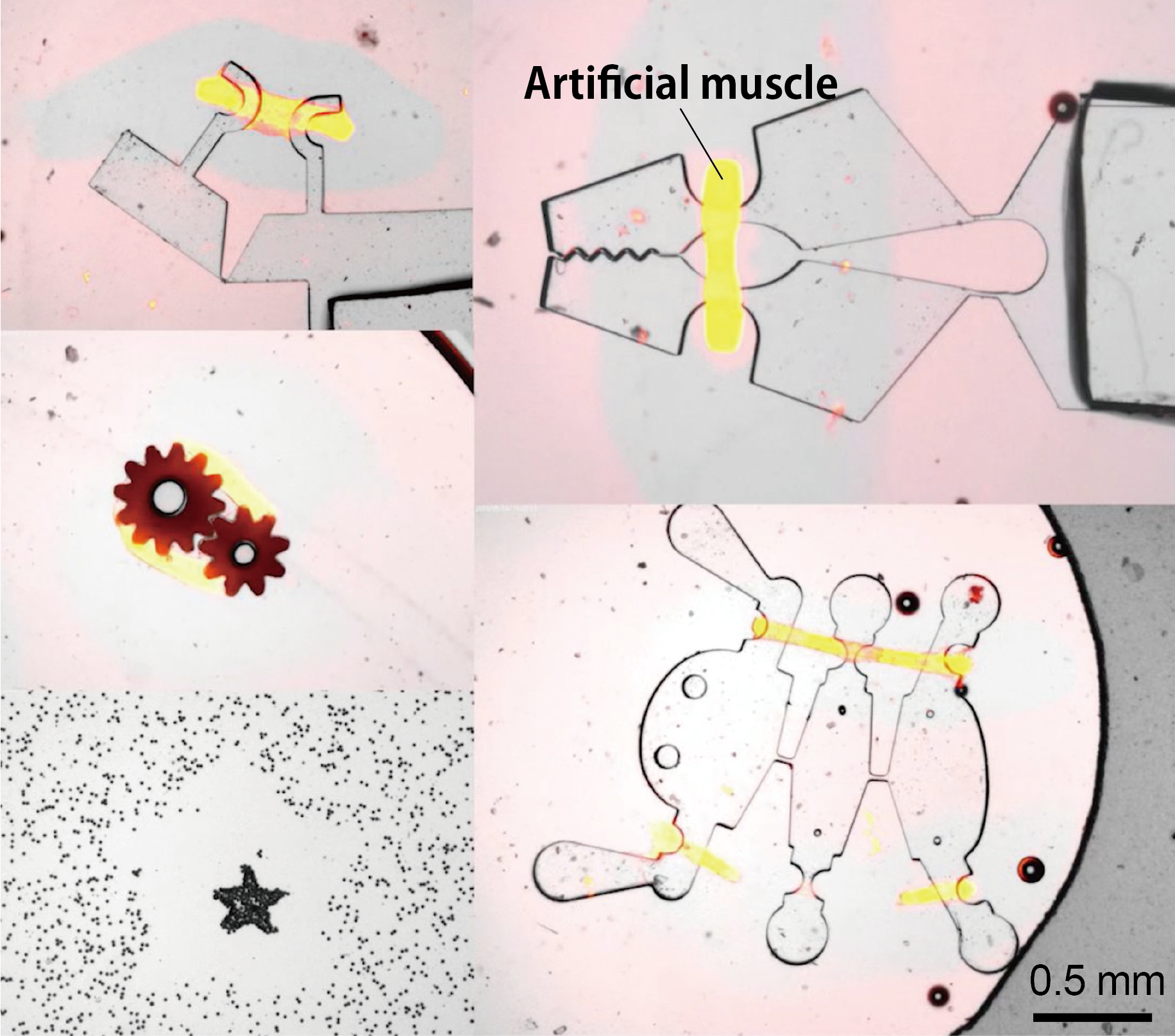
  Living organisms have developed diverse functions through evolution over a long period of time. One of these is a function related to mobility, which is necessary for life activities such as muscle contraction, the beating of cardiomyocytes, bacteria’s swimming and cell division. Nanometer proteins called motor proteins are integrated into motion assemblies with dimensions ranging from the micrometer-scale (bacteria) to the meter-scale (muscle). A motor protein is a molecular machine that converts chemical energy dissolved in water into dynamic force with great efficiency. This is an excellent property that conventional artificial motors do not have. At our laboratory, we are developing biohybrid micromachines using organic motors and microfabrication technology.

1Development of transfer element using kinesin and microtubules

  Kinesin is a kind of motor protein that transfers substances along microtubules in the nerve axon as a rail. If kinesin is fixed on a glass plate and microtubules and ATP are added to it, the microtubules move in random directions on the glass plate. Fine groove patterns are drawn on a glass substrate by photolithography, which is the basic technology for producing semiconductors, to accumulate kinesin on the microtrack. We have succeeded in controlling the motion of microtubules within the micro pattern by means of this technology. In addition, we have proven that it is possible to control the direction of microtubule motion to make one-direction revolution and transfer between micro spaces by using arrow patterns. Our finding has increased the possibility of kinesin and microtubules functioning as a transfer device, and has contributed to the development of microtransfer devices using this technology.

2Development of micro motors driven by bacteria

  There are bacteria that move on the surface of solid state substances, called gliding bacteria. This type of bacteria with motion capability can be a drive unit of micromachines. Using microfabrication technology of silicon and silicon dioxide film, we produced assemblies of several tens of micrometers. The gliding bacteria are connected to these micro assemblies to make micro motors. These motors turn two or three revolutions per minute stably with glucose in the solution as an energy source. They are the world’s first motors driven by organisms. Through the use of bacteria, we can expect to develop additional functions such as self-recovery and self-copying, which do not exist in conventional artificial systems.

Equipment

Protein purification device, PCR, supersensitive fluorescence microscope, micromanipulator, mask aligner, dry etching device, deposition apparatus

<Keywords>
Micromachine, Nanobiology, MEMS, motor protein
<Contact>
Yuichi Hiratsuka / E-mail:yhira@jaist.ac.jp TEL:+81-761-51-1591 FAX:+81-761-51-1149
VoiceInterdisciplinary approaches have been taken on the leading edge of science and technology. While studying life science and microprocessing technology, we are taking on the challenge of becoming pioneers of dream-inspiring technology.

The main research achievements in the past five years
  1. Y. Hiratsuka, Bacteria powered microrotary motor, Bionics, 26, 68-70 (2007).
  2. Y.Hiratsuka and S.Takeuchi, Toward a microrotary motor driven by motor proteins, MEMS2007, pp. 695-698 (2007)
  3. Y. Hiratsuka, T. Kamei, N. Yumoto, and T. Q. P. Uyeda, Three approaches to assembling nano-bio-machines using molecular motors, NanoBiotechnology, 2, 101-115 (2006).
  4. Y. Hiratsuaka, M. Miyata, T. Tada, and T. Q. P. Uyeda, Micro-rotary motor powered by bacteria, Proc. Nat. Acad. Sci., 103, 13618-13623 (2006).
  5. Y. Hiratsuka, M. Miyata, and T. Q. P. Uyeda, Living microtransporter by uni-directional gliding of Mycoplasma along microtracks, Biochem. Biophys. Res. Commun., 331, 318-324 (2005).