

Advancing human-AI design innovation from brain to build
Laboratory on digital empowerment and creative materialization (BRAINtoBUILD)
Professor:GEORGIEV, Georgi V.
E-mail:
[Research areas]
neurocognition, empathy, design, materialization
[Keywords]
AI, innovation, technology-enhanced learning, Human-AI collaboration, rehabilitation technology
Skills and background we are looking for in prospective students
Students from various disciplines who have the motivation to work across disciplinary boundaries, creating technologies that enhance human capabilities and wellbeing. Good English written and oral communication skills are essential.
What you can expect to learn in this laboratory
We conduct research on human-AI creative collaboration, neurocognition of design creativity, empathic design innovation, rehabilitation technology, and digital fabrication-enhanced learning, spanning the "brain to build" continuum from cognitive ideation to sustainable materialization. Research activities provide students with comprehensive skills in design thinking, user research, AI development, neurocognitive analysis, digital fabrication, and trans-disciplinary collaboration. We equip students with methodologies to tackle complex design innovation challenges by bridging cognitive science, empathic design, and advanced technologies, preparing them to create innovations that enhance human capabilities and societal wellbeing.
【Job category of graduates】 manufacturing, healthcare technology, innovation consultancy
Research outline
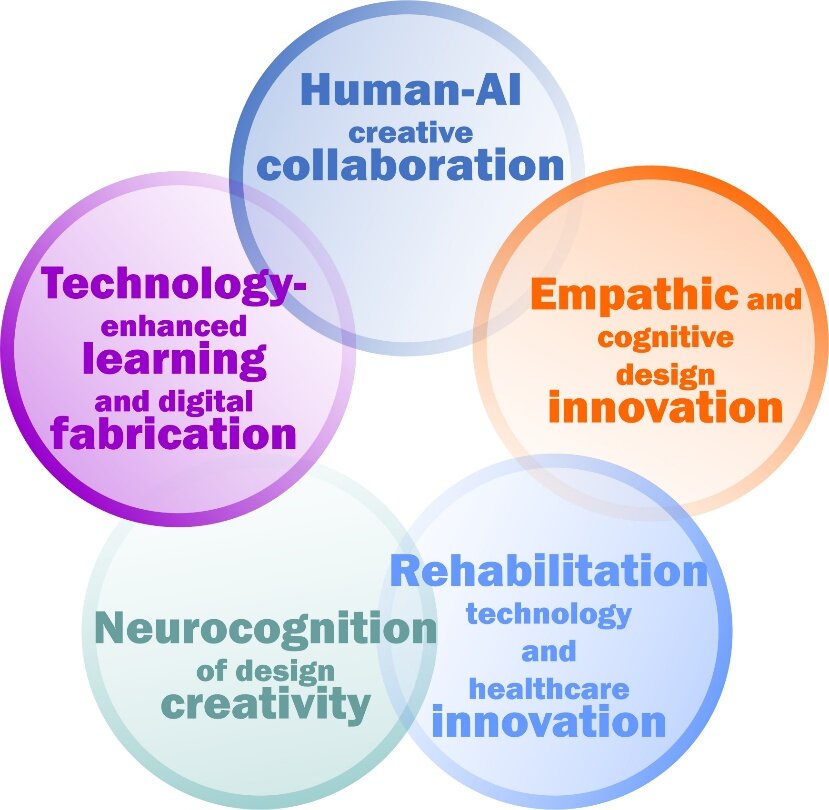
Figure 1. The five research
dimensions of the laboratory
The laboratory encompasses five research dimensions (Figure 1). Nevertheless, new relevant dimensions may arise during research processes. The present dimensions are as follows.
The human-AI creative collaboration dimension explores the utilization of generative AI as tools or means to enhance novelty, practicality, and surprise at the early stages of design.
The empathic and cognitive design innovation research dimension concerns ideation (idea generation), an essential and undervalued aspect in today’s highly technological society. Ideation is the first step leading to creativity and innovation, critical to the success of digital solutions, artefacts, products, services, and systems.
The rehabilitation technology and healthcare innovation research dimension explores the support of experiences of patients, designers of healthcare technology, healthcare providers, and other stakeholders in digital technology-enabled rehabilitation and activities of daily living (ADLs). The dimension encompasses a range of cognitive and/or physical conditions, such as post-stroke recovery, which pose an increased challenge for contemporary society.
The neurocognition of design creativity research seeks to link ideation's neurocognitive bases with design education, cognition, and collaborative design practices. Particular interest is in instructional practices and enhancing performance in the design process.
The technology-enhanced learning and digital fabrication (digital materialization) research dimension concerns sustainability, performance, quantification, and trans-disciplinary integration of all stakeholders (other backgrounds, schoolers, local businesses/communities) in materializing and prototyping utilizing makerspaces.
Key publications
- Soomro, S.A., Nanjappan, V., Casakin, H., Georgiev G.V. (2025) Fostering Technical Skills and Creativity in the Digital Fabrication Spaces, International Journal of Technology and Design Education.
- Gong, Z., Gonçalves, M., Nanjappan, V., Georgiev, G.V. (2024) Priming uncertainty avoidance values: Influence of virtual reality stimuli on design creativity in ideation. Computers in Human Behavior.
- Georgiev, G.V., Georgiev, D.D. (2023) Quantitative dynamics of design thinking and creativity perspectives in company context. Technology in Society, 74.
Equipment
Single-board computers, VR headsets, 3D printers, portable fNIRS sensors, portable EEG (electromyography) sensors
Teaching policy
We value autonomy and teach students how to reach their full potential. We provide the most assistance possible through basic study sessions and weekly meetings, allowing planning research projects that students enjoy and pursue research independently toward those goals. We also actively encourage international and national academic presentations and publications, as well as collaborative research, aiming to develop internationally active individuals.