
Challenging God's design of Materials using AI
Laboratory on Materials AI
Associate Professor:ICHIBA Tomohiro
E-mail:
[Research areas]
AI-featured simulation solution for Materials
[Keywords]
artificial intelligence, first-principles calculations, supercomputers, materials informatics, quantum chemistry, many-body electron theory, Monte Carlo methods
Skills and background we are looking for in prospective students
Math at the level of common education in science and engineering, linguistic and logical abilities required for literature surveys, Adaptability to become familiar with various problems in materials science, sociability suitable for highly international community, and strong intellectual curiosity unconstrained by specialization.
What you can expect to learn in this laboratory
On the supercomputing infrastructure that JAIST proudly maintains, we tackle a wide range of problems in materials science by leveraging AI and quantum computations. This endeavor is not about understanding systems created by humans, but about understanding creations of God. When confronted with the plain data obtained, considerable effort is required to develop sound interpretations and insights. Through careful surveys of prior studies and the formulation and positioning of research questions based on them, students acquire strong abilities in conceptualization and analysis. These qualities are indispensable for individuals who will lead projects in guiding roles in industry and related fields. In our supervision, we place greater value on theaccumulation of experience in thinking based on evidencethan on the mere acquisition of highly specialized andfragmented technical skills, and we conduct our researchguidance with this principle in mind.
【Job category of graduates】Simulation divisions in materials-related or ICT-related industries, research positions at national research institutes overseas.
Research outline
Materials science as a treasure trove of AI challenge
 AI-driven science enabled by large-scale and high-speed data processing has qualitatively transformed research in materials science. By virtually realizing combinations of fewer than one hundred types of atoms on computers and systematically performing quantum mechanical simulations, research aimed at designing unknown materials with high functionality is now advancing worldwide. Quantum world lies far beyond our classical intuition. Since outcomes cannot be known without actually performing calculations, simulations play a crucial role. For this reason, strong interest has also been expressed from industries such as materials, biotechnology, and pharmaceuticals.
Ability required in an era of 'services from materials design'
To prevail in market competition within the ICT industry, even major IT companies have begun independently developing device materials. The former way of Materials science with manual trial and error has been replaced by simulation-based exploration using AI, and materials development itself is being reshaped into a playing field of information science. With the aim of cultivating human resources urgently needed in this era, we are engaged in materials design solutions that leverage AI and quantum computing.
Expertise in maximizing the predictive reliability
For example, no matter how rapidly route prediction based on map data advances, if the underlying survey information is incorrect, prior knowledge becomes invalid and must be entirely revised. A similar situation exists in materials science, where AI-based predictions are widely highlighted. Our group maintains a strong international presence as professionals in what may be called 'survey reliability' in materials simulation.
Key publications
See our group webpage for the publications. We've published in such journals as JACS/ Angewande/ JCTC/Sci.Rep./Inorg.Chem./Phys.Rev.Mat./ J.Chem.Phys./ J.Comput.Chem./Appl.Phys.Lett.
Equipment
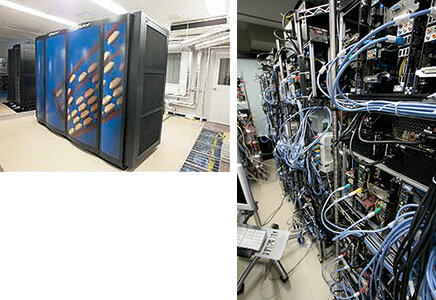
Supercomputing systems owned by JAIST and by collaborative partners in U.S.,
In-house GPU servers built and maintained by the laboratory, as well as in-house file server clusters.
Macintosh personal computers.
Teaching policy
We place strong emphasis on the capabilities required of individuals who can lead society as responsible degree holders. These include the abilities (1) to plan projects with careful assessments of feasibility and sustainability, rather than acting on impulsive motivations; (2) to make decisions by critically comparing possible options based on scientific reasoning, without clinging to a single opinion; (3) to manage multiple missions running in parallel; and (4) to take genuine pleasure in cultivating well-refined skills in document management, comprehension, and presentation, supported by rich and engaging vocabularies.
[研究室HP] URL:https://www.jaist.ac.jp/is/labs/hongo-lab/homepage2025/index.html