

Structurally understanding and deliberately controlling the illusions of seeing and body
Visual and Body Cognitive Informatics Laboratory
Associate Professor:MORI Masaki
E-mail:
[Research areas]
Cognitive Informatics, Vision Science, Psychophysics, Mathematical Psychology
[Keywords]
Visual illusion, Face perception, Body illusion, VR/AR/MR, Mathematical models
Skills and background we are looking for in prospective students
Our laboratory welcomes students who have an interest in one or more of the following areas: visual illusions, virtual reality, body perception, and social communication, and who possess an unwavering curiosity and passion for research. We recommend that students have knowledge in at least one of the following domains: psychological experiments, mathematical/data science, or information and communication technologies (ICTs). In addition, we broadly welcome students with skills and knowledge in related fields (e.g., artificial intelligence, control engineering, computer science, physical education, or art & design), as well as those with the ambition to learn thoroughly from the ground up.
What you can expect to learn in this laboratory
Students will acquire three key abilities. (1) Experimental Design Skills: Students foster the ability to demonstrate complex and intriguing cognitive phenomena as verifiable science. (2) Mathematical Phenomenology Skills: Students develop the skills to formalize cognitive phenomena using mathematical and statistical models, thereby explaining their underlying mechanisms. (3) Transferable Skills: Students acquire programming skills for software development and learn how to structure research papers and presentations for academic dissemination.
【Job category of graduates】 Research and technical positions in information and communications, entertainment, and healthcare
Research outline
Visual and body perception refers to the psychological processes through which we perceive and interpret external information obtained through vision, as well as internal information related to our own body. Elucidating the mechanisms and applying these insights to environmental design and information technology development are essential for building inclusive social systems that are aligned with human characteristics. From the perspective of cognitive informatics (integrating psychological experiments, mathematical and data science, and ICTs), our laboratory advances the understanding of diverse phenomena in visual and body perception, with the aim of enriching the society that surrounds human beings
(1) Elucidation, Utilization, and Creation of Illusory Experiences
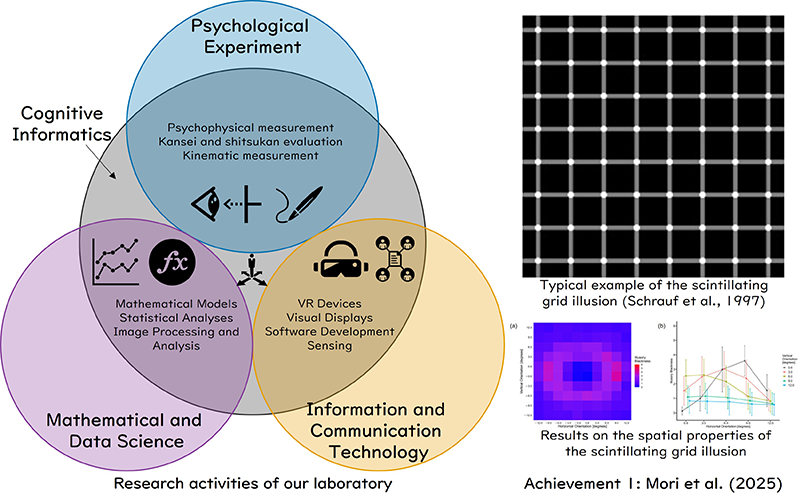 Our laboratory investigates diverse visual illusory phenomena using psychological experiments (psychophysical measurements) and mathematical/data science (differential equations, multivariate analyses) to generate novel illusions and elucidate visual information processing mechanisms. For example, we conduct research clarifying the spatial properties underlying the scintillating grid illusion (Achievement 1). In addition to scientific research, we engage in creative activities, proposing original works such as the blink-induced subjective color, the increased horikan for everyone illusion, and the crab walking illusion in the visual and auditory illusion contests.
(2) Liberating from Body Constraints in the R–V Continuum
Our laboratory conducts fundamental research toward the realization of cybernetic avatar technologies by integrating psychological experiments with ICTs (e.g., head-mounted displays, sensing technologies). In practical applications within virtual environments, avatars are often rendered semi-transparent or full-transparent due to camera angles or production constraints. We therefore empirically investigate how varying levels of avatar transparency influence the body illusions, providing evidence-based guidelines for designing embodied experiences (Achievement 2).
(3) Ensuring Safety and Security in AI–Human Ethics
Our laboratory explores how advances in image processing and generative technologies may impact psychological safety, as well as methods for controlling visually induced self-motion perception (vection), which is closely related to XR sickness. For example, we examine individual differences in processed self-face recognition and aim to establish guidelines for literacy education tailored to psychological properties (Achievement 3). We have also demonstrated that vection can be modulated by body movement (Mori & Seno, 2018).
Key publications
- Mori, M., Sushida, T., & Kondo, S. (2025). Spatial properties of scintillating grid illusion through visual experiments and numerical simulations. Vision Research, 228, Article 108560.
- Goto, K., Mori, M., & Nakatani, M. (2024). Full-body illusion of avatars with different transparency. Transactions of the Virtual Reality Society of Japan, 29(3), 119–126.
- Ayase, I., Mori, M., & Kato, T. (2023). Eye size recognition of self and others among people with self-face dissatisfaction. i-Perception, 14(1), 1–14.
Equipment
Hardware: Visual experimental apparatus, visual environment measurement equipment, XR devices, etc.
Software: Mathematical/statistical/image analyses, computer graphics generation, psychological experiment/survey systems, etc.
Teaching policy
Our laboratory aims to guide students in maximizing their strengths, interests, and abilities while fostering an enduring curiosity and passion for research. We emphasize not only teaching from the principal investigator, but also fostering relationships where students mutually enhance each other through discussions and advice among themselves. Students will acquire foundational skills in measurements, analyses, and programming, while conducting research in the science and technology of visual and body perception. Our findings will be actively presented at international conferences and published in international journals. Students will cultivate the capabilities to thrive internationally as individual researchers through active participation in seminars and meetings.
[Website] URL : https://morima.asia/