
Polymeric world inspired
by history of natural environment and biomaterials
Laboratory on DRY & WET Matter
Professor:OKEYOSHI Kosuke
E-mail:
[Research areas]
polymer science, photochemistry, soft matter
[Keywords]
polymeric gels, water, pattern formation, photo-functional materials, energy conversion, bioinspired materials
Skills and background we are looking for in prospective students
We are seeking individuals who have experience or fundamental knowledge about polymer science, physical chemistry, material science, photochemistry, and soft matter. In particular, individuals who can handle challenges, and are innately curious and persevering are encouraged to apply.
What you can expect to learn in this laboratory
Academic subjects: Polymer science, photochemistry, soft matter, interface and colloidal science, surface chemistry, geometry, and non-linear science. Additional skills: Logical thinking and understanding, experiment designing, scientific verification, high-quality presentations, ability to communicate in English.
【Job category of graduates】
Manufacture of chemicals, cosmetics, foods, materials, healthcare industry, etc.
Research outline
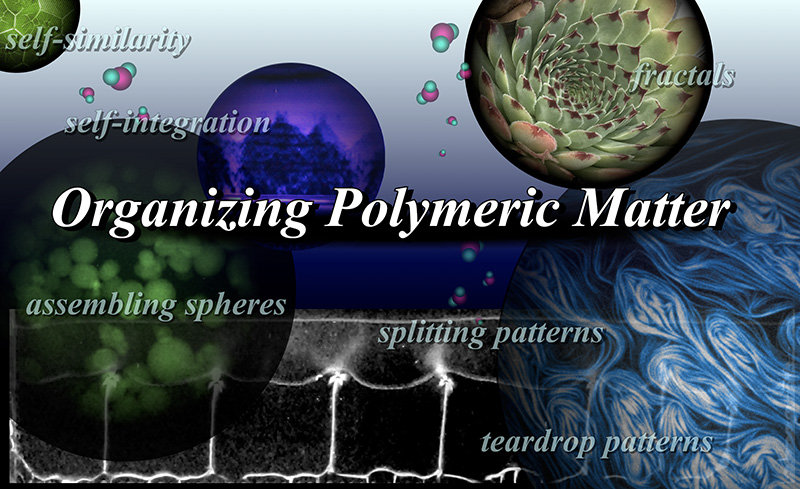
Looking around nature, we see many beautiful patterns. For example, while snowflakes are composed of water molecules, biological tissues are assembled from various small molecules, revealing geometric macro-structures. This does not originate solely from the material itself, but is the result of strong environmental influences. In fact, life has evolved to adapt to changing environments, resulting in diverse spatial patterns and rhythms.
Research to create patterns from soft materials such as polymers has a long history. These patterns contain physics and mathematics that transcend scales, and living organisms incorporate these principles to function and grow. In our recent research, we discovered a phenomenon in which polysaccharides, a biopolymer, reconstruct their own patterns. In particular, we are working on a phenomena, "meniscus splitting", in which a single interface splits into multiple. In this work, we have uncovered characteristics of pattern formation, such as symmetry breaking, asynchrony, and universality independent of polymer species. Here, why and how are patterns created? Our theme is to understand the significance of the underlying laws and universality that transcend scales underlying materials.
1. DRY & WET: polysaccharides express splitting phenomena
We are investigating the mechanism via which polysaccharides reproduce geometric patterns beyond molecular scale in vitro. In particular, by controlling physicochemical conditions, we are exploring the law of pattern formation exhibited from agueous solutions of polysaccharide under dry environment. In a non-equilibrium environment, polymers are reorganized in both micro and macro forms. Looking back at the fact that actual living organisms survive with maintaining their body moisture even in a dry environment, it should hold the key to unraveling the evolution of biopolymers that have migrated from water to land.
2. Pattern formation in soft materials and design of advanced materials
Regardless of whether it is a biopolymer or a synthetic polymer, most of soft materials can be morphologically controlled by stress at the materials’ interface. Only small environmental differences, such as slight changes in mechanical energy, can change shapes and patterns, e.g., spatial/temporal self-similarity. These patterns can be used as novel bioinspired materials that can efficiently adapt to the external environment.
Based on the exploration of natural beauty, the ultimate goal is to understand the significance of the laws in these phenomena. We are investigating one of the biggest enigmas of natural science, why does life create patterns?
Key publications
- Nonequilibrium period with emergence of Marangoni circulations in meniscus splitting. Wu L, Okeyoshi K, Advanced Materials Interfaces 13, e00655 (2026).
- Symmetry breaking in meniscus splitting: Effects of boundary conditions and polymeric membrane growth. Nguyen TKL, Hatta T, Ogura K, Tonomura Y, Okeyoshi K, Advanced Science 12, e3807 (2025).
- Design of open systems for meniscus splitting demonstrated using an aqueous polymer solution. Hagiwara R, Okeyoshi K, Science and Technology of Advanced Materials 26, 2512704 (2025).
Equipment
Optical microscopes, optical spectrometer, polarized light devices, image analysis devices, fluorescence measurement instruments, viscometer, densimeter, surface tension meter, dynamic light scattering, electron microscopes, etc.
Teaching policy
During the training period prior to working in society, we will support the selected candidate to expand his/her potentials to the best of our capacity. Our group provides a diverse environment both in terms of research and culture. This is a priceless opportunity for constructing a versatile scientific personality. Based on the above-mentioned research objectives, the candidate will consciously pursue research on the following lines:
1. Develop the abilities of logical thinking and foresight.
2. Design and verify hypotheses through experiments and discussions.
3. Learn to use scientific language for public outreach purposes.
[Website] URL : https://sites.google.com/oke-acgroup.com/web