


お知らせ news
Report
成長を超えた持続可能性を考える――循環経済と知識イノベーション
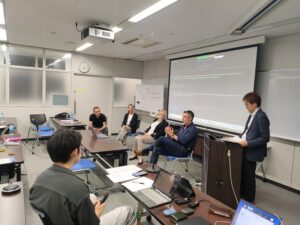
2026年9月14日,北陸先端科学技術大学院大学(JAIST)は,「Sustainability Beyond Growth」をテーマとする研究科セミナーを開催しました.このセミナーは本センターの白肌邦生教授のホストのもと,行われました.本セミナーでは,循環経済(Circular Economy:CE),ポスト成長,極限環境におけるホスピタリティという異なる視点から,限られた資源のもとで人間らしい生活と持続可能な社会をどのように実現するのかを議論しました.
最初に,Dejan Križaj氏とKaja Antlej氏は,宇宙や閉鎖環境を,資源に限りのある地球社会の縮図として捉える視点を示しました.こうした環境では,水や食料,エネルギーを循環させる技術だけでなく,食事,ケア,プライバシーなどを通じて,人間の尊厳や心理的安定を支えるホスピタリティも不可欠です.この議論は,CEを資源効率の問題だけでなく,人間らしい生活を支えるサービスの問題として考える重要性を示しています.
続いて,Oksana Mont氏は,欧州におけるポスト成長と持続可能な消費の研究を紹介しました.環境負荷を減らすためには,製品や生産工程の効率化だけでは十分ではなく,過剰な生産や消費そのものを見直す「充足性」の視点が必要です.何を成長させ,何を縮小させるべきかを社会全体で考え,経済成長だけに依存しないウェルビーイングの実現を目指す必要性が論じられました.
Charles Romito氏は,CEを企業や社会に実装する際の課題を,実務家の立場から提示しました.循環型の製品を開発するだけでは変革は進まず,回収や再利用の仕組み,企業間連携,事業モデル,評価指標,資金調達などを一体的に設計する必要があります.オランダのマットレス産業などの事例を通じて,CEには技術開発と経営・制度設計の両方が求められることが示されました.
パネル討議では,大学の役割についても意見が交わされました.大学には,新しい技術を生み出すだけでなく,企業,行政,研究者,市民など,立場の異なる関係者を結び付け,何を持続させるべきかを共に考える場を形成する役割があります.また,既存の成長観や効率性を当然視せず,社会の前提そのものを問い直すことも,知識科学と知識経営の重要な課題です.
CEは,廃棄物削減や資源循環のための技術に限定されるものではありません.その技術が誰にどのような価値や影響をもたらすのか,意思決定に誰が参加するのか,生活の質や公平性をどのように守るのかまで考える必要があります.この点は,研究やイノベーションの目的,プロセス,社会的影響を多様な関係者とともに検討するRRI(責任ある研究・イノベーション)の理念と深く結び付いています.
知識イノベーションセンターは今後も,RRIの普及・啓発を進めるとともに,技術的な可能性と経営的・社会的な視点を結び付け,持続可能な社会の形成に向けた対話と知識共創の機会を提供していきます.
詳しいレポートに関心のあるかたはこちらにご連絡ください.


Rethinking Sustainability Beyond Growth: Circular Economy and Knowledge Innovation
On 14 September 2026, the Japan Advanced Institute of Science and Technology (JAIST) held a seminar entitled “Sustainability Beyond Growth” hosted by Prof. Kunio Shirahada Drawing on perspectives from the circular economy (CE), post-growth thinking, and hospitality in extreme environments, the seminar explored how we can create a sustainable society and maintain a dignified human life within finite resource constraints.
Dejan Križaj and Kaja Antlej began by presenting space habitats and other closed environments as microcosms of our resource-constrained planet. In such settings, technologies for circulating water, food, and energy are essential. Equally important, however, is hospitality that supports human dignity and psychological well-being through everyday experiences such as food, care, and privacy. Their presentation demonstrated the importance of approaching CE not only as a matter of resource efficiency but also as a question of how services can sustain human life and dignity.
Oksana Mont then introduced European research on post-growth and sustainable consumption. She argued that improving the efficiency of products and production processes alone is insufficient to reduce environmental pressures. A perspective of “sufficiency” is also required—one that critically examines excessive production and consumption. Her presentation highlighted the need to consider collectively which areas should continue to grow, which should contract, and how well-being can be sustained without depending solely on economic growth.
Charles Romito addressed the practical challenges of implementing CE in businesses and society. Developing circular products alone does not bring about systemic transformation. Collection and reuse systems, inter-organisational collaboration, business models, performance indicators, and financing mechanisms must also be designed in an integrated manner. Through examples including the Dutch mattress industry, he demonstrated that CE requires both technological development and innovation in management and institutional arrangements.
The panel discussion also examined the role of universities. Universities are expected not only to develop new technologies but also to connect businesses, governments, researchers, and citizens, creating spaces in which stakeholders can jointly consider what should be sustained. Knowledge science and knowledge management can contribute to this process by questioning assumptions about growth and efficiency that have often been taken for granted.
CE is therefore more than a technical approach to reducing waste and circulating resources. It also requires us to consider who benefits from a technology, who may be affected by it, who participates in decision-making, and how quality of life and equity can be protected. In this respect, CE is closely connected to Responsible Research and Innovation (RRI), which encourages diverse stakeholders to reflect collectively on the purposes, processes, and societal impacts of research and innovation.
The Knowledge Innovation Research Center will continue to promote awareness and understanding of RRI while providing opportunities for dialogue and knowledge co-creation that connect technological possibilities with managerial and societal perspectives for a sustainable future.
If you have interests in full version of the report, please send an email to Prof. Shirahada.