
Innovating for a Greener Future through Advanced Materials Science
Laboratory on Energy Nanomaterials
Professor:NAGAO Yuki
E-mail:
[Research areas]
Protonics (Polymer Chem., Inorganic Chem., Coordination Chem., Physical and Interfacial Chem.)
[Keywords]
Hydrogen society, Ion-conducting materials, Interfacial design, Fuel cells, Batteries and flow batteries
Skills and background we are looking for in prospective students
We welcome international students who can actively communicate in English and work collaboratively in a research environment. Students are expected to engage proactively in research, take responsibility for their own projects, and gradually develop independence and leadership through daily research activities.
What you can expect to learn in this laboratory
Students learn to think independently, communicate research clearly in English, and develop problem-solving and data-analysis skills through daily research activities on ion-conducting materials and interfaces.
【Job category of graduates】
Energy-related industries, chemical and materials companies, and academic or research positions in home countries
Research outline
Our laboratory studies ion-conducting and active materials, as well as interfacial design, for energy devices such as fuel cells, batteries, and flow batteries, covering topics from fundamental ion transport to device performance.
Research Themes
- Fuel cell performance improvement
Studies on proton and hydroxide ion transport in organized polymer structures and thin films, with an emphasis on interfacial effects. - Rechargeable proton batteries
Development of proton batteries based on advanced electrode materials and electrolytes with organized structures. - Battery performance improvement
Research on ion transport and precise polymer arrangement at electrolyte–electrode interfaces for lithium-ion and related batteries. - Ion-transport-based sensing materials
Studies on ion transport responses to external stimuli, including gas sensing and mechanically induced alignment in polymer films. - Ion switching materials
Ion switching controlled by coordination compounds and external stimuli
(led by Dr. Aoki, Assistant Professor).
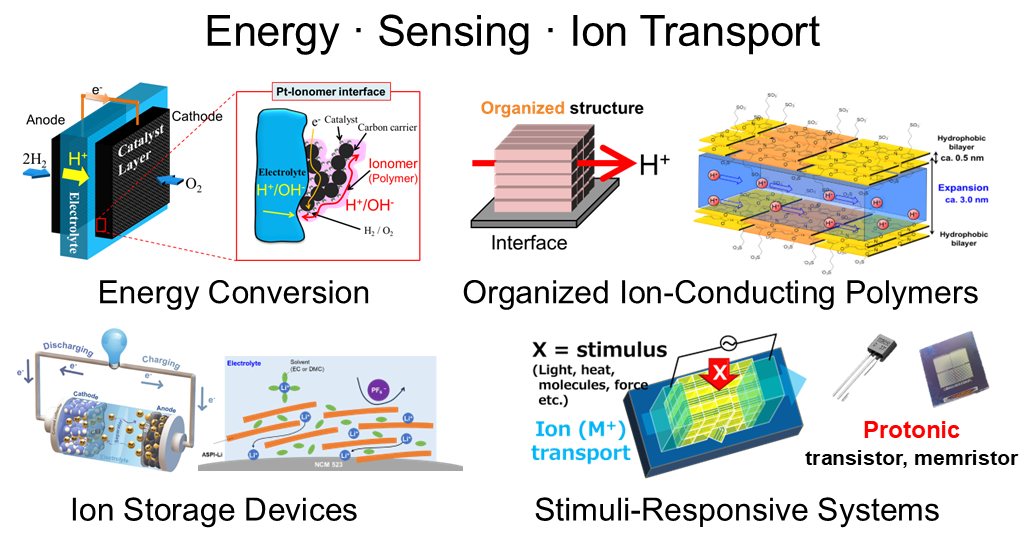
Figure Overview of our research concept integrating energy, sensing, and ion transport through organized ion-conducting polymers, interfaces, and device-oriented material design.
Key publications
- L. C. T. Cao, K. Aoki, S.-H. Hsu, S. Boonruang, Y. Nagao, Porosity-controlled MXene anodes for enhanced rate and long cycle life performance in aqueous proton batteries, Chem. Eng. J., 520, 165882 (2025).
- M. Marium, K. Aoki, Y. He, K. Yamamoto, A. Suwansoontorn, S. Ikuta, M. Hara, S. Nagano, Y. Nagao, K. Nishikawa, T. Miyazaki, H. Aoki, S. Kobayashi, T. Sudare, T. Hitosugi, N. Zettsu, Lyotropic polymer liquid crystal coating: Enabling lamellar ion-conduction pathways for superior C-rate performance in NCM523 cathodes, ACS Appl. Energy Mater., 8, 16589–16600 (2025).
- A. Taborosi, K. Aoki, N. Zettsu, M. Koyama, Y. Nagao, Molecular dynamics simulation of polymer electrolyte membrane for understanding structure and proton conductivity at various hydration levels using neural network potential, Macromolecules, 58, 3720–3727 (2025).
Equipment
Environmental-controlled measurement systems enabling ion-transport analysis under precisely controlled humidity and temperature (IR, QCM, GIXRS, and LCR-based measurements)
Electrochemical characterization facilities for batteries and interfaces
Cleanroom-based microfabrication facilities for interdigitated electrodes using photolithography and sputtering processes
Advanced structural analysis tools for ultrathin films and oriented polymers (e.g., vacuum-based MAIRS2)
Access to external synchrotron radiation and neutron facilities
Teaching policy
Students are expected to focus on research activities on weekdays and attend seminars regularly. Although no core time is set, research activities are encouraged mainly between 9:00 and 17:00 to maintain a balanced and productive research style.
Research topics are determined through discussion with the supervisor. We emphasize steady and continuous engagement with a research theme, while supporting students who are motivated to develop independence through daily research activities.
[Website] URL : https://www.jaist.ac.jp/ms/labs/nagao-www/?lang=en
[Facebook]