
Decision-making for the sustainable coexistence between environment and society.
Laboratory on Mathematical Sciences for Environment
Associate Professor:YOSHIOKA Hidekazu
E-mail:
[Research areas]
Mathematical environmental sciences, Social systems engineering
[Keywords]
Sustainability, mathematical science, resource management, environmental management, decision support, stochastic control and optimization theory
Skills and background we are looking for in prospective students
Having a wide range of knowledge in applied mathematics will greatly broaden the scope and deepen the quality of your research, so we strongly encourage you to acquire as much of it as possible. We also expect you to constantly strive for self-improvement on a daily basis, and to have an ambitious and proactive approach to acquiring the imagination to discover unknown similarities between seemingly disparate phenomena. Everyone can only learn a limited amount of things in a limited amount of time. Therefore, we also expect you to recognize that "research is a race against time."
What you can expect to learn in this laboratory
Knowledge and skills for investigating sustainable management of resources and the environment from a mathematical perspective, particularly related to modeling, control theory, and optimization theory. Mathematical and numerical methodologies for extracting the mathematical laws underlying limited data.
Research outline
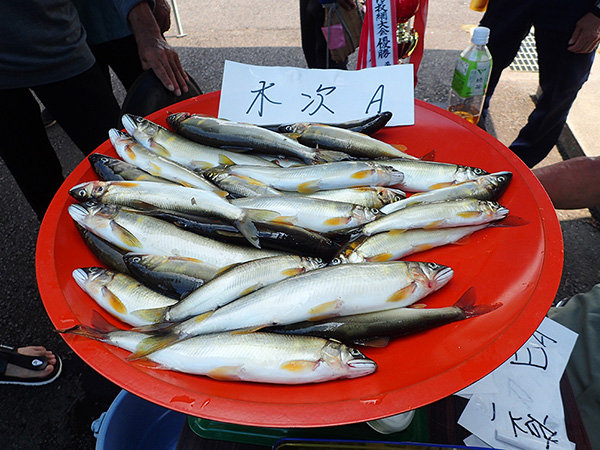 Photo 1:The harvested fish P. altivelis, Hii River.
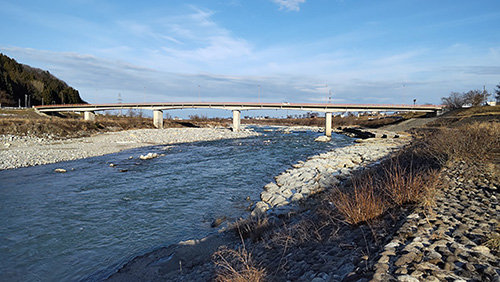 Photo 2:Near the Tsurugi hydrological observation station, Tedori River.
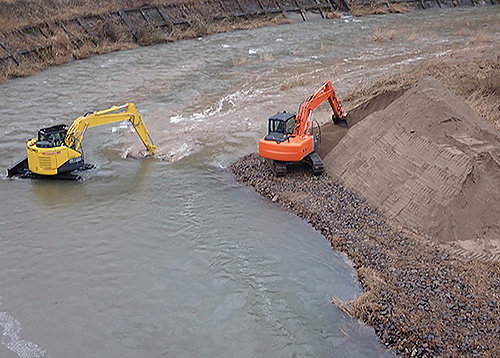 Photo 3:The sediment replenishment to counteract against the sediment starvation at Hii River.
The sustainable coexistence of the environment and society is a critical issue facing humanity. Especially now, there is a pressing need for wise use of the various biological resources (fish and crops) and energy resources provided by the natural environment. Furthermore, efforts at various scales, from local to national, and from individuals to organizations, are required to achieve carbon neutrality, or a decarbonized society. With this broad perspective in mind, our laboratory is conducting research to resolve various decision-making challenges faced in resource and environmental management. In particular, we actively incorporate concepts from modern mathematical science, constantly seeking innovative ideas, and ambitiously pursue a spiral of progress between theory and application (field). Recent research examples are listed below. In both cases, we aim for interdisciplinary research through the integration of different fields. Our research fields include the Tedori River (middle and upper reaches) in Ishikawa Prefecture and the Hii River (middle reaches) in Shimane Prefecture. In addition to the research described below, we are also conducting research on a unique mountain stream fish that inhabits the Tedori River.
Resource management of Ayu Sweetfish
Ayu (Plecoglossus altivelis altivelis) , a familiar inland fishery resource to Japanese people, has a unique life cycle that lasts only one year (Photo 1). In Japan, Ayu catches have been declining since the 1990s, while the fisheries cooperatives responsible for resource management have been steadily declining due to a decrease in fishermen and members and an aging population. To overcome this difficult situation, it is necessary to intelligently collect information within limited costs and extract cost-effective resource management policies from that information, i.e., to effectively transform the information into knowledge. This research begins with the voluntary collection of biological information related to ecology of Ayu, and then works on mathematical formulation of the growth of individual Ayu and populations, and on deriving a resource management schedule based on optimal control theory. We are also working on advanced mathematical modeling of the spring Ayu upstream migration.
Mathematical modeling of aquatic environments
Aquatic environments such as rivers and lakes (Photo 2) are home to numerous organisms, not just sweetfish. The rise and fall of these organisms is determined by the dynamics of the aquatic environment (i.e., the quantity and quality of water). Furthermore, the use of water resources for hydroelectric power generation, agriculture, industry, and daily life all have mutual influences on the aquatic environment. In this research, we are exploring a mathematical methodology that is simple yet capable of skillfully extracting the dynamics of the aquatic environment, without necessarily being bound by existing hydraulic and hydrological frameworks. For example, we have found that by applying infinite-dimensional stochastic differential equation systems that have been discussed in the fields of economics, finance, and insurance, it is possible to reproduce the physical characteristics of river flow. This is a very interesting example that shows the applicability of something that at first glance seems completely unrelated to "water."
Decision-making under risk and uncertainty
We are studying decision-making that confronts the challenges inevitably faced in practice, namely, risk, which is a potentially extremely undesirable event that can occur in resource and environmental management, and uncertainty resulting from a lack of quality or quantity of information. This research, too, aims to cover everything from mathematical foundations to real-world applications. For example, in the former, we understand risk indicators under uncertainty through function spaces with rich mathematical structures, such as Orlicz spaces, and develop numerical calculation algorithms for them. In the latter, we are working on sustainable real-world control of risk indicators in areas such as hydroelectric power generation, sediment return (Photo 3), and environmental monitoring.
Key publications
- Yoshioka H.: CIR bridge for modeling of fish migration on sub-hourly scale, Chaos, Solitons & Fractals, Vol. 199, Part 2, 116874, October 2025. https://doi.org/10.1016/j.chaos.2025.116874
- Yoshioka H., Yoshioka Y.: Non-Markovian superposition process model for stochastically describing concentration–discharge relationship. Chaos, Solitons & Fractals, Vol. 199, Part 2, 116715, October 2025. https://doi.org/10.1016/j.chaos.2025.116715
- Yoshioka H.: Generalized replicator dynamics based on mean-field pairwise comparison dynamic. Mathematics and Computers in Simulation, Vol. 236, 200-220, October 2025. https://doi.org/10.1016/j.matcom.2025.04.010
Teaching policy
Research topic will be determined through a discussion between the student and staff. We may prepare a variety of research topics, ranging from mathematical modelling, numerical computation, to field surveys at some river, lake, dam-reservoir system, or farmland. We often need to find out the mathematical structure hidden behind the limited data; the same real-life data cannot be obtained never again. Both students and the staff will have presentations at the seminar to share mathematical methodologies to deepen their research topics with each other.
[Website] URL : https://www.facebook.com/profile.php?id=100057653101504