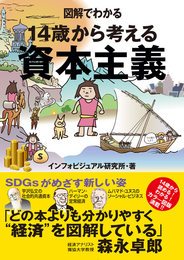
『Understanding Capitalism Through Illustrations: A Guide for 14-Year-Olds』
Ohta Publishing (2020/11/4), ISBN-13: 978-4778317232

『Degrowth: The Economy Key Ideas』
EDINBURGH University Press (2018 June), ISBN 9781911116790
Series: Learning about cutting-edge science and human history to prevent social division
"In the 15th century, European nations began venturing across the seas in search of new territories. This marked the beginning of the Age of Discovery. The enormous costs of these voyages were, of course, subsidized by wealthy merchants. While voyages were dangerous and carried the risk of failure, when ships reached uncharted territories and brought back rare goods, the merchants who funded them received a share and made a fortune. They then used their increased wealth to invest in the next voyage. This was the prototype of 'capitalism,' but their wealth was seized from invaded and colonized lands, built upon the sacrifices of others." (Quoted from book [2-1], pages 26-27).
"The system that emerged in the 17th-century England transformed family structures, beliefs, morals, and production systems into forms suitable for a new world governed by markets and money. Many changes occurred as the result, but most notably, a class emerged that sold their labor to buy necessities. For thousands of years prior to that, most people had shaped societies to sustain their families and communities, but they were forced to abandon that way of life. The enclosure of the commons deprived them of the ability to maintain traditional ways of life, giving rise to factory-based handicrafts linked to gender and racial discrimination. (omitted) An unequal exchange, in which one party takes too much from the others, was justified as necessary for the growth of profits." (Quoted from book [2-2], pages 43-44).
"Industrial capitalists, who invested money to own factories and machinery, hired workers, produced goods, and made profits. This was the beginning of the capitalist economic system. (omitted) Capitalists buy labor as a commodity, make workers work until they produce value exceeding their wages, and profit by 'exploiting' (squeezing out) this 'surplus value.' This system allows only capitalists to become wealthy." (Quoted from book [2-1], pages 30-31).
"Socialism aimed to prohibit exploitation, a harmful aspect of capitalism, to manage everything collectively, and to ensure equal distribution for all citizens. However, political leaders resorted to dictatorship and corruption, and workers were burdened with excessive quotas under the planned economy." With declining work ethic and productivity, and reality far removed from the ideal, the socialist Soviet Union collapsed in 1991. Meanwhile, the imperial European powers lost their national strength after starting World War I, and the stage for capitalism shifted to the emerging nation of America. The form of capitalism also changed. (omitted) From the 1980s onward, there was a renewed demand for economic freedom, and 'neoliberalism' was born. This American-style economic system rapidly expanded throughout the world after the collapse of the Soviet Union. Giant corporations and financial capital that had emerged victorious from the competition penetrated every corner of the world, and economic globalization progressed." (Quoted from book [2-1], pages 32-33).
"While claiming to support developing countries, policies such as thorough deregulation of markets, privatization of state-owned enterprises, and deregulation of foreign capital are implemented, ignoring individual economic and cultural differences. It was as if a giant bulldozer was leveling the ground, destroying the environment, and then American multinational corporations were parachuting in afterwards. Literally, 'the freedom of the strong' was exercised. This was the face of the 'global economy.' Japan was also swallowed up by this wave of the global economy. The same bulldozers ran around in the name of economic reconstruction and structural reform." (Quoted from book [2-1], pages 66-67).
"American ecological economist Daly says that the current economy, in its pursuit of growth, is causing economic losses to the environment and society, resulting in 'diseconomic growth' where the benefits outweigh the costs. (omitted) Even if GDP increases, human happiness (life satisfaction) does not increase." (Quoted from book [2-1], pages 76-77).
"Sharing food in daily life, securing a place to live, participating in the community, and engaging in dialogue." (Quoted from book [2-2], page 72).
"Wage labor and goods with market prices never exist in isolation; they have always existed alongside care work and social reproduction labor that do not involve wages or prices in supporting us" (Quote from book [2-2], pages 73-74).
"It is considered indispensable for enabling people to lead prosperous economic lives, develop excellent culture, and sustainably and stably maintain a humane society." (Quote from book [2-1], page 51).
"In an environment where systems that protect private property and emphasize competition are in place and considered normal, it is inevitable that efforts to create and maintain mechanisms for sharing and collaboration will be difficult, and questions may arise about whether this is the right approach. That is precisely why mutual support among collaborative networks is necessary. Furthermore, the structure of policies, systems, and resources must be reviewed to create more favorable conditions." (Quoted from book [2-2], page 74).
"Dignified work, reduced selfish competition, fair relationships between people and the environment, identities not ranked by individual superiority or inferiority, cohesive communities, a humane rhythm of life, and respect for nature are both goals and means of degrowth." (Quoted from book [2-2], pages 152-153).
The above outlines how society became increasingly greedy from the early modern period and the Industrial Revolution, and how it became particularly problematic with neoliberalism since the 1980s. In Episode 3, we will explain how a society based on mutual assistance has actually been commonplace throughout human history.
|
|
[2-1] Info-visual Research Laboratory,
『Understanding Capitalism Through Illustrations: A Guide for 14-Year-Olds』 Ohta Publishing (2020/11/4), ISBN-13: 978-4778317232 |
|
[2-2] G. Kallis,
『Degrowth: The Economy Key Ideas』 EDINBURGH University Press (2018 June), ISBN 9781911116790 |