
『The Success of Open Source』
Harvard University Press(2004), ISBN-13: 978-0674018587
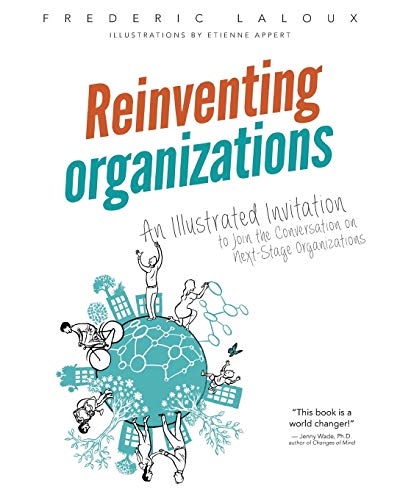
『Reinventing organizations: an illustrated invitation to join the conversation on next-stage organizations』
Nelson Parker(2016), ISBN-13: 978-2-9601335-5-4
Series: Learning about cutting-edge science and human history to prevent social division
"Property-protected source code is the cornerstone of the traditional intellectual property rights system in computer software. (omitted) Open-source software easily overturns this logic. The essence of open-source software is that the source code is free. That is, the source code of open-source software is made publicly available to users along with the software. In this case,'free' means freedom (not necessarily free of charge). Free source code is publicly available and non-exclusive. In Richard Stallman's terms, freedom means using the program for any purpose, studying its operation, and modifying it as needed. The right to redistribute copies to others, improve the program, and share the improvements within the community so that everyone benefits—this is included in the code. Programmers express this in simple terms. The 'free' in free software doesn't mean 'free beer', but 'free discussion'." (Quoted from book [8-1], pages 14-15).
"The text of Steven Levy's 'Hackers' touches upon the profound impact that the rise of monopolistic software in the late 1970s and early 1980s had on the MIT community. Many skilled programmers were poached by software startups with lucrative offers, and MIT began requiring its staff to sign confidentiality agreements. (omitted) For him, software was not merely a tool to run computers; ultimately, it was an expression of human creativity and expression. More importantly, software was a vital product of a community working together to solve problems for the common good. In other words, it was a problem of technology used by humans, but also a problem of the society in which humans live. Monopolistic software directly contradicted the moral sensibilities of a sound society. (omitted) Contrary to the claims of mainstream intellectual property law, exclusive ownership does not motivate people to write good software. On the contrary, applying traditional ownership to software turns helpful neighbors into 'pirates'." (Quoted from book [8-1], pages 66-68).
"In 1984, Stallman resigned from his position at MIT. To dedicate himself to 'free software',he founded the non-profit organization FSF (Free Software Foundation). His goal was to create a completely free OS that anyone could download, modify, and freely distribute. (omitted) Software licensed under the GPL cannot be monopolized, and derivative works of free software must also be free. The GPL further advanced this idea, prohibiting the use of GPL-backed code in monopolies. The GPL does not permit mixing free programs with 'non-free' programs." (Quoted from book [8-1], pages 68-70).
"The essence of open source is not the software itself, but the process by which the software is created. (omitted) The production process, or the way of making something, is far more important than the artifact produced, because it spreads much more widely. For example, Toyota pioneered lean manufacturing in its automobile factories. Twenty years later, this method had permeated the entire industrial economy. Similarly, open source has established itself as a method of software creation." (Quoted from book [8-1], pages 78-79).
"The behavioral logic of open-source users and programmers did not originate from abstract theory. Nor did they engage in serious discussions about how to maintain large-scale, distributed collaboration to derive the necessary challenges and procedures. It was born from trial and error. (omitted) Here are eight principles that capture the essence of what people do in open source: 1. It's fun, and it gets done. 2. It addresses every need. 3. Start over as little as possible. 4. Solve problems in parallel as much as possible. 5. Utilize the law of large numbers. 6. Document what you're doing. 7. Release early, release often. 8. Talk a lot." (Quoted from book [8-1], pages 98-110).
"Art and beauty, work as a calling, a common enemy, ego expansion, reputation, or identity and belief systems" (Quoted from book [8-1], page 180).
"Control stifles creativity, but information processing should ultimately lead to creativity" (Quoted from book [8-1], page 191).
Now, let's consider the problems of current corporate organizations that have stemmed from software development, with a broader generality applicable to various industries. There will be much overlap with what has been discussed so far, but the problem can be expressed as follows: It goes beyond whether it is easy to work; the very securing of workplaces is being threatened. This is not unrelated to the increase in restructuring and non-regular employment since the spread of neoliberalism. The global, yet superficial, issues outlined in the first Episode are also negatively impacting employment, which deeply concerns us personally. I think that we finally understand it clearly.
"Corporate organizations are greedy and ruthlessly pursuing profit and growth. The gap between this and reality continues to widen today. And this kind of mismanagement can be seen in various organizations. As far as we know, non-profit organizations, despite their noble purpose, are not providing better jobs. The same is true for government agencies. They have turned hospitals into soulless factories, and nurses are all leaving. Teachers, too, are not able to nurture the hearts of both teachers and students." (Quoted from book [8-2], page 21).
"Around 10,000 years ago, we entered a new Red (impulsive) stage. Societies of thousands emerged, and to cope with this entirely new level of complexity and maintain social order, the role of chief emerged. Chiefs used violence when necessary. Research shows that people of this era ran organizations in a fairly impulsive and self-centered way. They also lacked internalized rules." (Quoted from book [8-2], pages 27-29).
"Amber (conformist) organizations follow stable, reproducible processes, like agrarian societies. (omitted) They invented formal titles, duties, and command structures. Those in higher positions think, and those in lower positions execute. (omitted) Everyone knows their role. Through established rituals and processes, everyone can come to know the purpose of life." (Quoted from book [8-2], pages 30-33).
"This is a paradigm (worldview) brought about by science and the Industrial Revolution. At this stage, we no longer see the world as a fixed entity governed by universal rules of truth and falsehood. Instead, we view it as a complex world operating clockwork, governed by internal mechanisms and natural laws understandable through exploration. We believe that if we can understand and manipulate the world faster, smarter, and more innovatively than others, we can achieve greater success, wealth, profit, market dominance, and much more. (omitted) The scientific Industrial Revolution brought us freedom and prosperity. However, at the same time, we began to see a great shadow obscuring the future. One is the shadow of 'too much demand for change,' which manifests in our basic needs. Corporations try to create needs, supplying even illusions that people don't truly need. They advocate for more ownership, more new trends, a younger body, and claim that these are the keys to happiness. It has reached the stage of pursuing 'growth for growth'." (Quoted from book [8-2], pages 34-41).
"People at this stage begin to keenly notice the shadow cast by orange (achievement-oriented) organizations. This includes awareness of issues such as attachment to materialism, social inequality, loss of community, and environmental destruction. People strongly desire close and harmonious bonds with others. Green (pluralistic) organizations assert that all people have fundamentally equal value and that all voices must be listened to. (omitted) 'Culture' is a wonderful and powerful set of values that drives an organization. We understand that it truly has power. However, eliminating centralization and expanding delegation of authority is not easy! This is the contradiction inherent in the green (pluralistic) organizational model. While it desires egalitarianism and seeks participant consensus, it preserves the hierarchical pyramidal structure of an orange (achievement-oriented) organization. Herein lies a truly perplexing disconnect between values and reality." (Quoted from book [8-2], pages 42-46).
"The worldview of this Teal (evolutionary) organization is no longer a fixed, God-given concept (Amber: conformist), nor is it like a complex, soulless machine (Orange: achievement-oriented). Instead, it views this world as a stage for a journey to express our true selves. It expands the potential of each of us and unlocks our innate talents. (omitted) We are freed from the preconditions of 'how we should be.' (omitted) In a Teal (evolutionary) organization, we begin by letting go of our 'ego.' We learn to observe our 'ego' from a distance, and through this, we realize that the fears, ambitions, and desires born from the 'ego' have been subtly manipulating our lives. In this way, we learn to minimize the control or the exert by trying to impress others or conform to those around us. As a result, we develop the ability to trust others and increase our confidence in life." (Quoted from book [8-2], pages 52-53).
"The founders of Teal organizations use entirely different metaphors. Surprisingly, a common way to describe Teal organizations is as 'living organisms' or 'living systems.' Life is, They manage an unfathomable and beautiful ecosystem, employing all their wisdom toward evolution. And they evolve toward a higher level of wholeness, complexity, and a conscious organization. Without command and control from a center, every cell and every organism seeks self-organization and changes naturally. (omitted) Teal organizations bring three breakthroughs that fundamentally challenge the management we know today. (1) Self-management: Teal organizations have found the key to transforming from a hierarchical, bureaucratic pyramidal structure into a fluid system that distributes and delegates collective intelligence and power. (2) Wholeness: Teal organizations always encourage self-liberation, rather than confining oneself to a narrow world of 'specialization'. Teal organizations are developing a consistent way of realizing that allows us to remove the masks that hide our true selves. They reclaim the 'wholeness' deep within our hearts and lead all our colleagues toward it. (3) A constantly evolving purpose: Teal organizations possess a life of their own and maintain a self-sustaining methodology. They do not predict or control the future. Members are encouraged to understand that they should surrender to the direction the organization is naturally heading and listen to it." (Quoted from book [8-2], pages 72-74).
In Episode 9, we will explain, based on cutting-edge network science and resilience science, why decentralization is essential for both corporate organizations and social infrastructure networks.
|
|
[8-1] S.Weber,
『The Success of Open Source』 Harvard University Press(2004), ISBN-13: 978-0674018587 |
|
[8-2] F.Laloux, A.Etienne,
『Reinventing organizations: an illustrated invitation to join the conversation on next-stage organizations』 Nelson Parker(2016), ISBN-13: 978-2-9601335-5-4 |