
『Beyond the Valley』
MIT Press (2020), ISBN 9780262539609
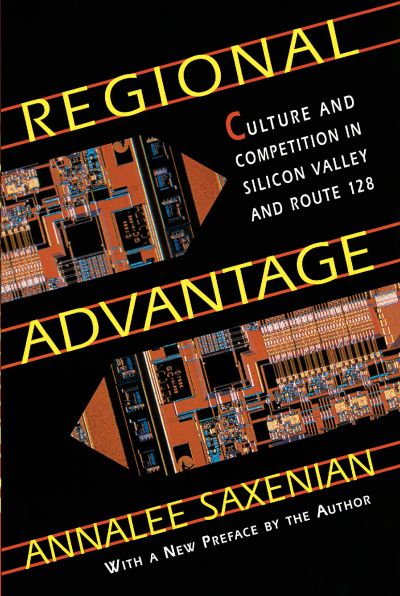
『Regional Advantage: Culture and Competition in Silicon Valley and Route 128』
Harvard University Press (1994), ISBN-13: 978-4822247782
Series: Learning about cutting-edge science and human history to prevent social division
"Throughout this book, I have shared stories that are transforming the current power dynamics surrounding the internet. These stories remind us that we don't need to follow the top-down patterns that Silicon Valley and perhaps even Chinese tech companies take for granted today when providing access to digital technology. From Brooklyn to Detroit and Catalonia, we have witnessed mesh networks being built from the ground up and becoming successful connectable entities. They demonstrate the potential for every user to create and use technology in a way that benefits them and prevents them from being exploited in the shadows. Communities that are being exploited for data and money can also gain control over the deployment of technology, enabling them to make decisions about jobs, skills training, and educational opportunities. I have shown that even indigenous people living in the cloud forests and jungles of southern Mexico can build their own mobile phone networks. Thanks to co-ownership, these communities were able to redistribute the money earned from projects to support their families and local organizations." (Quoted from book [7-1], page 189).
"Sasha Meinlas, a researcher and political activist who has explored community networks for nearly 20 years, has warned of the dangers of a digital future that prioritizes the pursuit of profit without regard for the sacrifice of others. Consider 'disaster capitalism' as an example. When people affected by hurricanes, earthquakes, or fires need help, private companies may end up funding these events without delivering services to those who truly need them. However, instead of being exploited, communities can cope by creating and maintaining their own resilient solutions, such as mesh networks (think of them as a collection of interconnected points that exchange data directly and dynamically without layers). (omitted) The Brooklyn, New York community network 'Red Hook WiFi' was one of the few communication infrastructures that functioned in the neighborhood after Hurricane Sandy in 2012, and has since been expanded to support the neighborhood in preparation for future disasters." (Quoted from book [7-1] pp. 10-11).
"In inland cities, the poor are left behind, Black and Hispanic people were particularly numerous. They had lost their jobs and the safety nets that jobs provided. As a result, several neighborhoods of the city were abandoned and taken over by gangs and drug activity. (omitted) In 2014, Nucella and her team, in collaboration with the Fair Internet Initiative and the Media Alliance Project, formed the Detroit Community Technology Project to develop technologies to serve and support the community. Technology awareness is only part of the larger goal of providing young people with basic literacy and education and supporting small and medium-sized businesses looking for partners and customers. (omitted) Detroit's community network, designed to support expanded user sovereignty and self-determination, continues to attract attention. (omitted) It is the future of the internet, truly rooted in civic ethics and values, fostering collaboration within and outside of cities, non-profit organizations, philanthropists, community organizers, and corporations."(Quoted from book [7-1] pages 12-13).
"Because power grids are not developed throughout Africa, numerous off-grid power startups such as Greenlight Planet, D-Light, Off-Grid Electric (OGE), M-Copa Solar, Phoenix International, and BBOXX have emerged. Drones, generally considered advanced technology that 'jumped in' from the wealthy parts of the world, are being used in countries like Rwanda to deliver medical supplies to remote areas. On the African continent, people without formal engineering education (i.e., those outside the expert class of the continent) are also active as technological innovators. In cities across the African continent, hardware repairs are frequently carried out on the streets, giving new life to technologies that would be considered outdated in the West (such as older iPhones)."'Quoted from book [7-1] page 46).
"The mountainous region of Oaxaca in southern Mexico is the most biologically and culturally diverse area in the Americas. There, a technological restructuring is underway, and the Indigenous Communities Communications (TIC) project, the world's largest community-owned mobile phone network, is located. TIC is an organization founded in 2012 by hackers, activists, and leaders of local indigenous communities. Born from centuries of philosophy, TIC, based in Oaxaca de Juárez, has built independent mobile phone networks owned by each of the more than 63 indigenous communities of the Zapotec, Mystec, and Mije tribes. This initiative has provided daily service to over 3,500 people despite the most challenging conditions for building communication networks in Mexico: high altitude, rain, dense forests, and a lack of reliable infrastructure such as electricity. (omitted) The name of Rhizomatica, the non-profit organization that supported the establishment of TIC, is derived from the philosophers Gilles Deleuze and Félix Guattari. They used the term 'rhizome' to reject the common view that knowledge produced in the center is transmitted to the periphery." (Quoted from book [7-1] pages 93-101).
"In the European Union (EU), measures to improve transparency in high-tech companies came into effect in May 2018. The General Data Protection Regulation (GDPR) sets out legal measures and fines as means to give users the opportunity to know how their data is used and to choose whether or not to consent to such use. The European Commission has invited a high-level group of experts (known as the HLEG) to advise on policy efforts to address fake news and online misinformation (defined as false, incorrect, or misleading information that harms the public). (omitted) Technology can be designed with short-term and long-term impacts on values such as fairness, justice, and diversity in mind (if the designers truly value these values). Instead of the 'act fast and destroy' slogan once advocated by Mark Zuckerberg, we should embrace the belief of 'act slowly and don't destroy'." (Quoted from book [7-1], page 160).
"The conclusion of this book is that unless technology companies, inter-company relationships, and the surrounding financial, educational, and public sector institutions all open up their boundaries, this region cannot compete on equal footing with Silicon Valley. (omitted) In the 1980s, several computer companies were founded in the Route 128 region. But by the early 1990s, industry giants—Cisco, 3Com, Bay Networks—were based in Silicon Valley. (omitted) Just as with semiconductors in the 1960s and microprocessor-based computers in the 1980s, the center of gravity of this dynamic new field in the computer network sector is clearly shifted westward." (Quoted from book [7-2] pages 4-6).
"In that region along Route 128, there is a lack of opportunities for collective discussion. In Silicon Valley, countless forums bring together people from all walks of life—from corporations and industries to government, private sector, finance, education, and training organizations. These gatherings, both formal and informal, provide people—even if they are obvious competitors—with opportunities to discuss common issues. They debate solutions and define a shared identity that allows the industry community to transcend the interests of individual companies. Only such industry communities can create and recreate regional advantages in today's competitive global economy. (omitted) In short, the economic fate of Silicon Valley and Route 128 is still defined and determined by important organizational and cultural differences." (Quoted from book [7-2] pages 8-9).
"Silicon Valley lacked a historical industrial background and was far removed from existing economic and political organizations, making it easier to experiment with novel and productive relationships. Frederick Terman, who attempted to transplant the technology community model from Massachusetts to California, fostered a more open and reciprocal relationship between Stanford University and local industries than that of the Route 128 region." (Quoted from book [7-2], page 58).
"Drawn by the challenges of geographical and technological frontiers, pioneers created a technology culture that transcended companies and job functions. They developed less formal social relationships and a tradition of collaborative work that supported experimentation. The companies they created were organized as loosely connected alliances of engineering teams. Unbeknownst to them, Silicon Valley engineers and entrepreneurs were creating a more flexible industrial system, one organized not around individual companies, but around the entire region and its professional and technological networks." (Quoted from book [7-2], page 62).
"Geographical proximity fosters iterative interaction and mutual trust to maintain collaboration, accelerating the continuous combination of technologies and skills. (omitted) Even if an industrial system is geographically concentrated, its adaptability may be limited; this is overwhelmingly a result of organizational structure, not dependent on technology or company size. The industrial system of Route 128 produced countless new companies and technologies, but the speed at which its producers adapted and commercialized them was insufficient to support the regional economy." (Quoted from book [7-2] pages 279-280).
In Episode 8, we will explore the possibility of countering neoliberal capitalist enterprises from a different perspective than cooperatives such as joint investment and one person, one vote—from the viewpoint of organizational culture and type.
|
|
[6-2] R.Srinivasan,
『Beyond the Valley』 MIT Press (2020), ISBN 9780262539609 |
|
[7-2] A.Saxenian,
『Regional Advantage: Culture and Competition in Silicon Valley and Route 128』 Harvard University Press (1994), ISBN-13: 978-4822247782 |