

Can Synaptic Connectivity Alone Reveal Neuron Types?
Neuronal Type Assignment from Connectivity (NTAC) identifies neuronal cell types using synaptic wiring patterns alone
Researchers show that synaptic wiring patterns alone can identify neuron types in fruit fly brain connectomes. Their method, NTAC, assigns neuronal types based solely on synaptic connectivity. With just 2% of neurons pre-labeled, it exceeds 90% accuracy in the fruit fly visual system and runs in minutes on a standard computer. A fully label-free version still reaches about 70% accuracy, enabling scalable cell typing as connectome datasets grow.
Recent technological advances facilitate the reconstruction of complete brain connectomes in small organisms and partial connectomes in mammals, involving the mapping of the network of neurons and synaptic connections. Accurate cell typing of these connectomes aids in interpreting circuit functions and comparing brain organization across species. Traditionally, cell typing relied on manual morphological classification by experts-- a slow process that required detailed anatomical information. However, morphology can be deceptive or inadequate in many brain regions, especially in circuits with repeated cell types, where neurons can share very similar morphology despite differing in connectivity.
In a recently published study, researchers have developed Neuronal Type Assignment from Connectivity (NTAC), an automated system that delivers high-precision results and runs efficiently even on conventional computers, demonstrating that synaptic connectivity alone contains sufficient information to identify neuronal types without relying on morphological features. The article is the result of an international collaboration between the Japan Advanced Institute of Science and Technology (JAIST), the Princeton Neuroscience Institute, the University of Edinburgh, and the Technical University of Catalonia. The research was led by Dr. Gregory Schwartzman, Associate Professor at JAIST, and also included Dr. Ben Jourdan from the University of Edinburgh, Dr. David García-Soriano from the Technical University of Catalonia, and Dr. Arie Matsliah from Princeton University. The article was published in Volume 17 of Nature Communications on January 6, 2026. It was featured on the Editors' Highlights page, which aims to showcase the top papers recently published in the area.
Explaining their research, Dr. Schwartzman says, "Our research comes in the context of expanding connectomes and a growing need for automatic and scalable tools. As connectome datasets grow, manual cell typing becomes a bottleneck. NTAC is capable of assigning neuronal types based exclusively on synaptic connectivity, with very high accuracy. It shows that the wiring diagram itself carries enough signal to identify neuron types quickly, even when only a small fraction of neurons is labeled."
The researchers developed two operational modes for NTAC. One is a semi-supervised version, where a small fraction of neurons is pre-labeled, and the algorithm uses connectivity patterns to infer the types of the remaining neurons. In the unsupervised version, no prior labels are required; the algorithm groups neurons purely based on similarities in their wiring.
The algorithm was applied to multiple state-of-the-art fruit fly brain connectomes, and the accuracy of NTAC was compared to morphology-based approaches that rely on NBLAST, a widely used method for comparing neuronal shapes. In the optic lobe, a region where neurons tile space and are difficult to distinguish morphologically, NTAC substantially outperformed the NBLAST-based classifiers. While morphology-based methods required many more labeled examples and still struggled to reach 50% accuracy in some settings, NTAC surpassed 90% with a fraction of the labeled data and in only minutes on a laptop.
In the fully unsupervised mode, NTAC achieved around 70% accuracy, far exceeding morphology-based clustering methods, which often remained below 10%. For the full brain, which contains thousands of unique cell types, unsupervised accuracy reached 52%, an encouraging result given the scale and complexity of the data.
"The long-term objective of connectomics is to map the complete human brain and derive scientific and medical insights from it, similar to how biology and medicine were revolutionized by genomics. Currently, complete connectomes have only been mapped for very small organisms such as fruit flies. NTAC can accelerate the creation and analysis of connectomes, potentially speeding scientific discovery, and, in the future, may contribute to efforts to classify neuronal cell types in large-scale mammalian and eventually human connectomes. This algorithm has already been applied effectively to label thousands of neurons in the brain-and-cord connectome (BANC) dataset. The next frontier in connectomics is mapping the mouse brain, and our algorithm can play a substantial role in this endeavor," explained Dr. Schwartzman.
Further developing the algorithm by incorporating multimodal data can enhance classification performance and yield a more comprehensive understanding of neuronal cell types.
Image 1:
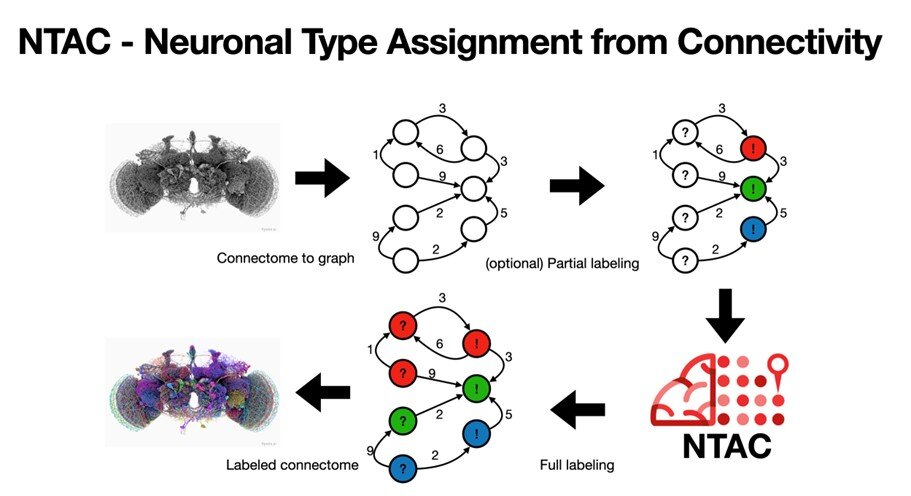
Image title: NTAC identifies neuronal cell types using synaptic connectivity patterns alone
Image caption: Neuronal Type Assignment from Connectivity (NTAC) transforms a connectome into a graph, and detects neuron types using "connectivity fingerprints" and groups the neuronal cell types in the connectome.
Image credit: Gregory Schwartzman (connectome image from flywire.ai)
Image source link: N/A
License type: Original content
Usage restrictions: Credit must be given to the author.
Image 2:
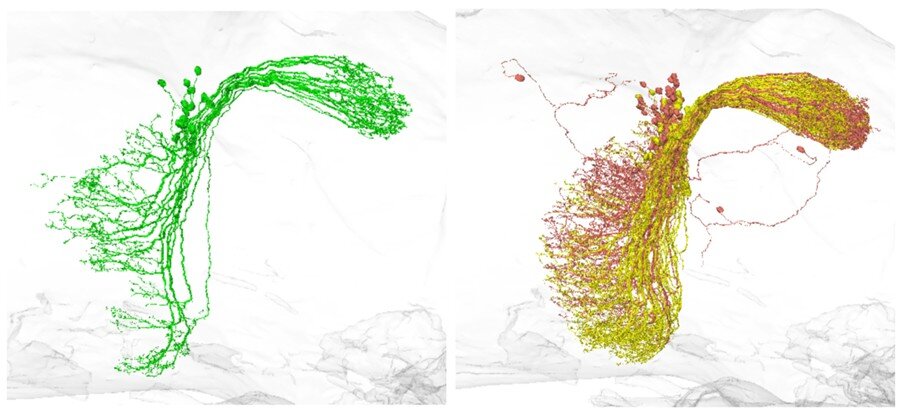
Image title: NTAC: A new algorithm outperforms traditional cell typing methods
Image caption: Left: Neurons of a specific type labelled by human experts. Right: Neurons of the same type labelled by NTAC.
Image credit: Gregory Schwartzman (created using Codex viewer from flywire.ai)
Image source link: N/A
License type: Original content
Usage restrictions: Credit must be given to the author.
Reference
| Title of original paper: | NTAC: Neuronal type assignment from connectivity |
| Authors: | Gregory Schwartzman, Ben Jourdan, David García-Soriano, and Arie Matsliah |
| Journal: | Nature Communications |
| DOI: | 10.1038/s41467-025-68044-1 |
Additional information for EurekAlert
| Latest Article Publication Date: | 06 January 2026 |
| Method of Research: | Computational simulation/modeling |
| Subject of Research: | Not applicable |
| Conflicts of Interest Statement: | The authors declare no competing interests. |
Funding information
Arie Matsliah was supported by funding provided through grants to Murthy and Seung from the NIH BRAIN Initiative (RF1 MH117815, RF1 MH129268, U24 NS126935). Gregory Schwartzman was supported by the following research grants: KAKENHI 25K00370, JST ASPIRE JPMJAP2302, and JST CRONOS JPMJCS24K2. Ben Jourdan was supported through an EPSRC Early Career Fellowship (EP/T00729). David García-Soriano was supported by the Spanish Agencia Estatal de Investigación AEI/10.13039/501100011033 (Project PID2020-112581GB-C21 MOTION).
March 19, 2026
