Research
Soft Sensors
1) Fabric Sensor with Proximity and Tactile Sensing
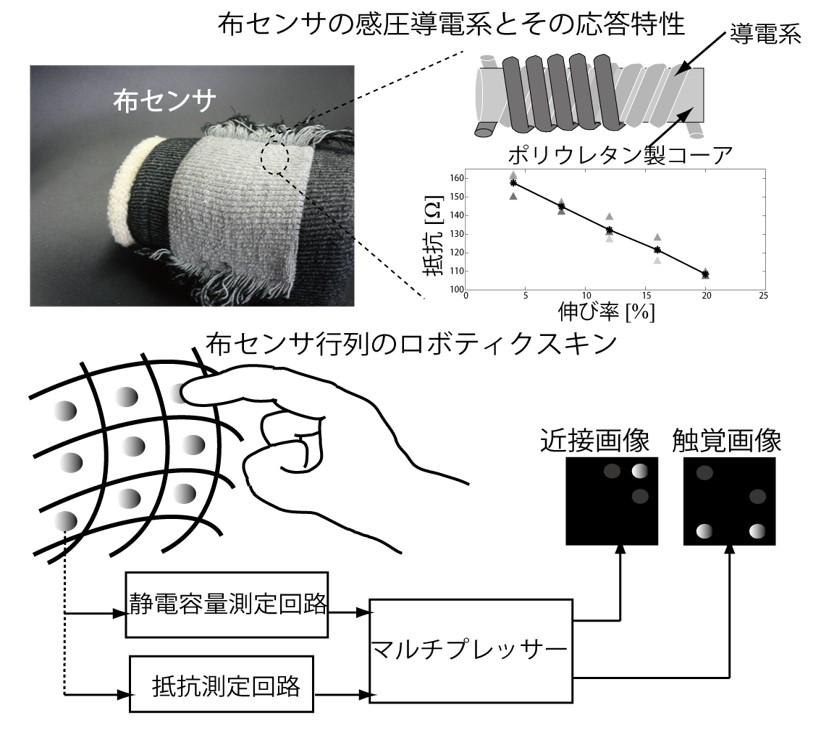
Human-in-the-loop task involving soft contact has become common in robotic application, especially in physical human-robot interaction. In this task, it is required that robot would sense interactions of human by touching or sliding, as well as assess possibility of touch pattern when human is approaching by proximity sensation. In addition, it is also essential to fabricate an interface so that human does not feel uncomfortable during long-run physical interaction with robot. We attempt to fabricate a soft interface (or a robotic skin system) completely constructed from fabrics and soft materials that can sense both proximity and applied force from human's touch, and especially the sliding event on its surface. The skin consists of a matrix of sensing elements that is able to cover any curvature in a robot body. Each sensing element can sense the relative distance of conductive object (or human body) that is approaching the sensing element's surface, 2x2 contact force distribution when the object makes contact with the sensing element, and onset of slippage . By exploiting simultaneous measurement of capacitance, each fabric sensing element can smoothly switch the proximity mode and tactile mode based on position of the object. We also constructed a model that can predict variation of capacitance measurement of proximity and tactile modes during operation for further analysis. The methods and results presented in this paper can be extended to construct a larger scale of robotic skin for robot's body, and act as a platform for study human-robot interaction.
2) Morphological Computation in Tactile Sensing
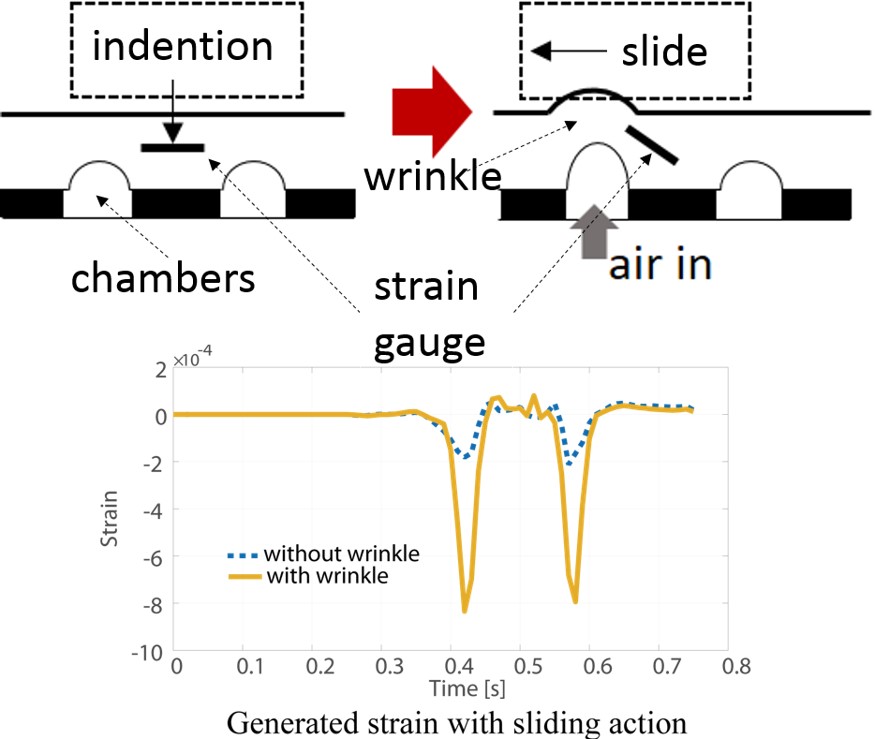
We proposed an active tactile sensing system that selects sensing modalities based on specific sensing tasks, by changing its morphology, called Wrin'Tac. This work was inspired by the human finger wet-induced wrinkle, which is usually observed when one soaks in warm water for a period, and has been indicated as an efficient transformation for enhancement of gripping stability in a wet environment. We proposed a device which is an integration of actuation (pneumatic actuator) and sensing elements (strain gauges) inside a thin, multi-layered substrate. Under pressurization, the morphology of the substrate surface (both geometrical and mechanical characteristics) change with appearance of wrinkles. Especially, by formation of wrinkles, this device can change its shape so that the posture of embedded sensing elements (strain gauges) can vary and generate different responses depending on external load conditions. As a result, this device can actively select its sensing functions depending on specific sensing tasks. First, we created a model to investigate the dynamic changes in a strain gauges' mechanical response under formation of wrinkles. Then, a prototype of this sensing device and its fabrication process were proposed to accomplish sensing tasks under vertical indentation and horizontal sliding action on its surface by using one type of strain gauge. This work is an example of soft morphological control in tactile sensing, and is expected to open a new avenue to development of tactile sensing systems. This is also an implementation in a broader idea on VANmorph, Variable Afferent Network morphology.
Soft Robotic Hands
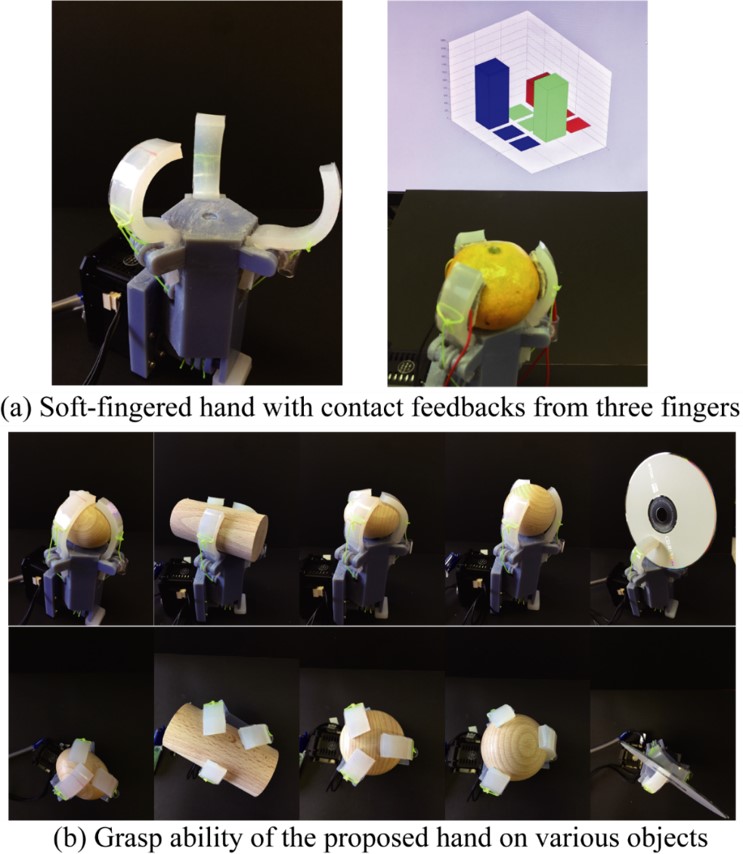
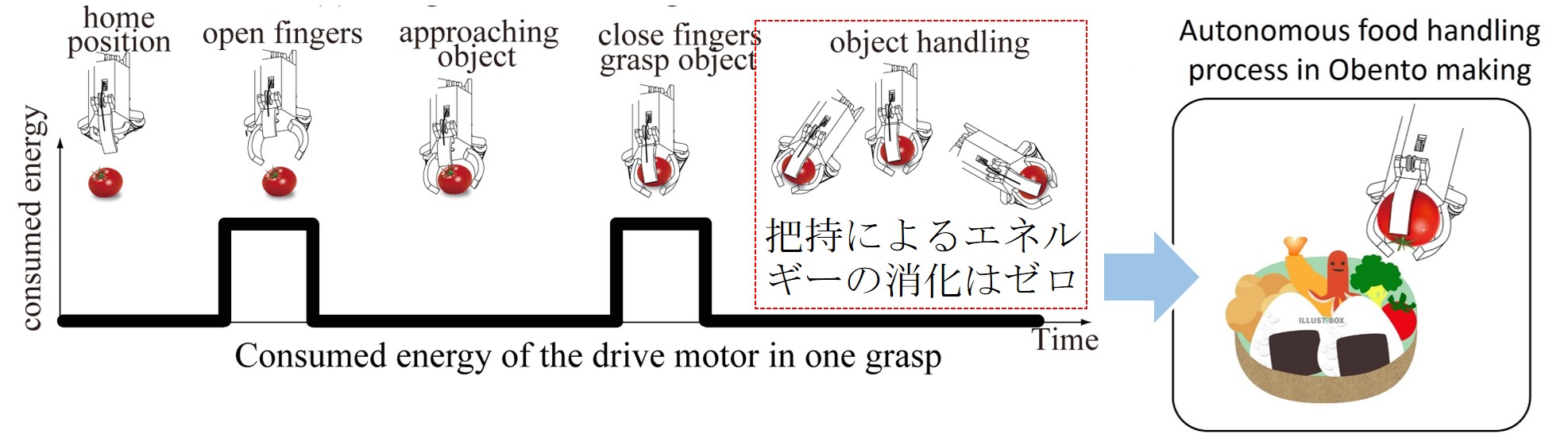
We proposed a novel approach to the fabrication of a soft robotic gripper/hand with contact feedback for grasping delicate objects. Each finger has a multilayered structure, consisting of a main structure and sensing elements. The main structure includes a softer layer much thicker than a stiffer layer. The gripping energy of the fingers is generated from the elastic energy of the pre-stretched softer layers, and controlled by simple tendon strings pulled/released by a single actuation. Due to the pre-stretching and the difference in moduli among layers, the shape/posture of the fingers in stable state is similar to that of soft fingers actuated by pressurization. Then, we were able to design a soft-fingered hand for different applications by changing the morphological shape of layers. In addition, the hand includes a soft, flexible, and stretchable sensing element for the detection of contact and applied force, which can also be used in other designs of soft fingers. We assessed the ability of the proposed soft hand to grasp food products with feedback of contact location. The experimental results showed that the proposed hand could safely grasp light and delicate objects, such as fruits, and that it could possibly distinguish among objects based on feedback from sensors. The design proposed in this paper may give rise to other soft hand designs, along with the possibility of using morphological imbalanced deformation of multilayered structures in soft robotics research.
Haptic Displays
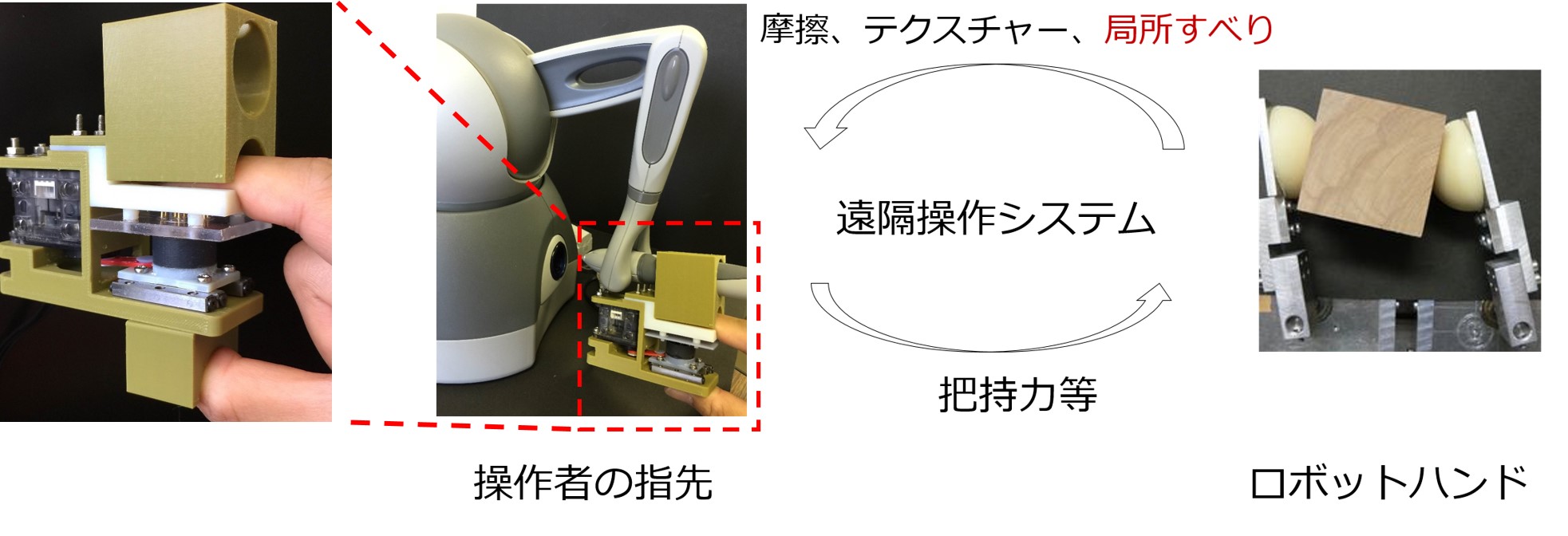
Human-in-the-loop task involving soft contact has become common in robotic manipulation research, especially in tele-operation and robotic surgery. Soft contact in this task may include a soft-fingered robot hand gripping a rock, or robotic control of forceps to pick up a tissue sample. In these scenarios, operators normally struggle with controlling the gripping force of the remote robotic hand, so that the grasped object is neither dropped nor damaged. Information about slippage, especially incipient slippage (or pre-slide), occurring at the contact surface is not properly sensed by the operator through cutaneous tactile feedback. This study aimed to generate pre-slide sensation on human fingertip for enhancement of slip perception of soft objects. We hypothesized that use of a method that can reproduce localized slippage can enhance human perception of slippage based on our previous study of soft-based contact. We created a grounded slip haptic display device, which can efficiently assess partial slippage on a human fingertip efficiently using a bundle of pins under only one actuation. This paper focuses on the creation of the device, including its theoretical underpinnings and design process, as well as assessing its efficiency in enhancing skin stretching through static and dynamic simulations. The device can be utilized to assess the slide process of a human fingertip, perceiving how and when slippage occurs on the contact surface; and can act as a platform for studies