The fundamental problem lurking in the concentration of links to a few hubs, which is the root cause of extreme vulnerability to attacks, as explained in
Episode 9, is not limited to networks. A similar pattern can be broadly applied to the subjugation resulting from centralized monopolies in relationships between powerful and weak nations, the rich and the poor, cities and rural areas. That is, the vast majority of other nodes connect to hubs for their individual efficiency, resulting in a concentration of links to a few hubs. This leaves the connectivity of the entire network to these hubs (making it easily fragmented by even a small hub attack). This means that the peripheries of weak nations, the poor, and rural areas unjustly accept the demands of the centers of powerful nations, the wealthy, and cities for convenience and short-term gains. As the result, the majority of the profits flow back to the center, the periphery is subjugated, marginalized, and exploited. These problems are usually hidden and difficult to see, but their true nature is revealed during major disasters.
"Nearly two years have passed since the Great East Japan Earthquake and the Fukushima Daiichi nuclear disaster. For many people, this disaster may already be a thing of the past. However, this earthquake disaster is not yet over. The situation is still ongoing, and there are even signs that something new is about to begin. (omitted) What questions should we ask, and what should we address? What should we be asking? That remains unclear. This book will explore them from a sociological perspective. There are three keywords: wide-area system, center and periphery, and subjectivity. These are all interconnected." (Quoted from book [10-1], page 9).
This wide-area system can be said to be primarily a social infrastructure network related to electricity, gas, water, communications, transportation, and logistics. Alternatively, it could be considered the very structure of the economy in modern society.
"Japanese society now forms a single, vast system that extends across a wide area. This earthquake has created a situation that threatens the very existence of this 'wide-area system.' Wide-area systems have a 'center and a periphery.' The earthquake occurred in Tohoku, a peripheral region of Japan, and a new peripheral area, the disaster zone, has spread widely within Tohoku, pushing many people into the outermost periphery. (omitted) In this wide-area system where everything is marginalized, only the system itself manages to survive. And even that survival is not something that is actively aimed for, but merely a result, where humans exist only as objects. However, this marginalization of humanity itself did not begin with the earthquake, but seems to have been happening even before that. (omitted) This 'marginalization of humanity' seems to be related to what has recently been the subject of 'the objectification of people' in European thought. This earthquake shows that a similar situation is steadily progressing within Japanese society. No, its destination seems likely to be even more grim than that of Western Europe." (Quoted from book [10-1], pages 10-11).
The Orange (achievement-oriented) organization, which can be considered a clockwork machine as outlined in
Episode 8, is precisely based on the 'objectification of people'. In modern society (especially through wide-area systems), we are unknowingly marginalized and subjugated. On the other hand, such wide-area systems (i.e., various networks of social infrastructure) have become indispensable for daily social life and economic activities. Therefore, it is necesssary to improve the connectivity, if the current scale-free structure explained in
Episode 9 remains unchanged, it will fall apart and malfunctions by not only major disasters but also a few hub attacks. We will discuss what measures should be taken to create a resilient network structure with the ability of reconstruction in
Episode 11.
"Human life in modern Japanese society now consists of vast, wide-area systems. Our lives are within infrastructure such as electricity, gas, and water, high-speed transportation networks, and communication networks such as telephones and the internet. (omitted) Furthermore, we live within a global network of goods distribution, and we cannot live a single day without the benefits of a vast and widespread market economy. (omitted) Of course, this is not limited to consumption. It is most evident in production, and the supply chain breakdowns that became a problem this time were symbolic events of this earthquake. Production in one location is linked to production processes that unfold worldwide, and a breakdown in one location directly affects production activities around the world. (omitted) This convenient system broke down that day." (Quoted from book [10-1], pages 28-29).
"What this earthquake has revealed is that, in this 21st-century society, it seems that without a large-scale system in place, neither a home nor individual life can exist. (omitted) When such a large-scale system collapses, the condition for rebuilding life naturally becomes waiting for the system to recover. However, even when rebuilding the system, the system itself only existed because people lived within it. In a place where everything has been lost, the disaster-stricken areas are burdened with the extremely difficult task of simultaneously regenerating the system that supported the region and the lives of people in their homes." (Quoted from book [10-1], page 87).
The image of local areas being subjugated, reduced, and losing their autonomy was particularly evident in the nuclear accident. While not slavery, doesn't it feel almost indistinguishable from colonial rule?
"The incorporation of local areas into the formation of a large system by the central government has been seen in various situations throughout Japan over the past few decades, not just in municipalities with nuclear power plants. (omitted) Incorporating small societies on the periphery into a large system and making them subordinate to the central government. Moreover, the risks and failures that arise in that process are forcibly transferred to the central government by temporarily granting it enormous profits. As the result, the burden is shifted onto smaller societies. This is not limited to nuclear power plants. It can be said to be an essential characteristic of wide-area system societies. (omitted) Neither tsunami damage nor nuclear accidents are problems that can be dealt with by small societies, given the structure of modern society. The system in which we live, once it breaks down, is such that individuals cannot restore that society on their own. (omitted) Individuals, families, and small communities are powerless, and we can only wait for someone to come and restore the system." (Quoted from book [10-1], pages 36-39).
Even if there is some justification for individual responsibility in normal circumstances, it does not apply at all in situations like these during disasters, yet unfortunately, the same kind of response is being taken. And does the central government have any agency? It seems not. Perhaps due to the negative effects of individualism, the central government also seems to think that as long as it is good for them (convenient and profitable, etc.), that's all that matters. This way of thinking seems to be widespread. And the idea that relief funds, originally intended to help those in need, should be used for personal profit, is based on the disaster capitalism quoted in
Episode 7.
"At least after observing this earthquake for over a year and a half, what I've come to realize is that, even when considering the relationship between local and central areas, nothing seems to be changing in the central area. On one side are the local areas, and on the other is the metropolitan area or central government. However, the central government is not the driving force behind this system; it is merely the center in the sense that it can exercise its own ego within this relationship." (Quoted from book [10-1], page 43).
"Nuclear power plants are a prime example of a wide-area system. It could be said that this disaster occurred precisely because everything is interconnected within that wide-area system. However, the resulting accident is treated as the responsibility of only a few people. (omitted) Since the Fukushima Daiichi Nuclear Power Plant belonged to Tokyo Electric Power Company, the relationship between the two should be inextricably linked, but people in the Tokyo metropolitan area do not have the same sense of ownership as the people of Fukushima Prefecture. (omitted) The center is clearly visible from the periphery, but the periphery is invisible from the center. It's like the center of a mortar and pestle and its rim; from the rim, everything inside the bowl is visible, but those at the bottom of the bowl can only see themselves and cannot see their surroundings." (Quoted from book [10-1], page 167).
And then the wide-area system broke down, and social division occurred in every aspect of life.
"The various aspects of division are not spatially caused by evacuation orders or radioactive contamination, but are observed in various other, multidimensional ways. The most significant of these are generational divisions and occupational divisions. And regarding those who were forcibly displaced, the division stems from differences in the type of housing they came from." (Quoted from book [10-1], page 172).
"For disaster victims, their lives are a whole. They are not made up of infrastructure alone, or jobs alone, much less houses alone. Everything is combined to make life possible. However, the experts and various organizations that provide support only see and operate within the parts they are involved in. Moreover, this often originates from the center of each subsystem, and while we cannot survive without the help of these subsystems, the more help we receive, the more fragmented and marginalized our lives become." (Quoted from book [10-1], pages 242-243).
The situation of being marginalized and dependent, which is immediately unchangeable, is similar to the current global situation pointed out in
Episode 1, albeit on a different scale. Towards a solution, the degrowth introduced in
Episode 2 and the cooperative initiatives introduced in
Episodes 6 -
Episode 7 are foreshadowed by the Western modern approach described in
Episode 4. It can be said that we should reconsider ideas such as "Houtoku" (a philosophy emphasizing moral virtue).
"The exposure of the limits of nationalism and economic supremacy, and the collapse of scientific supremacy—all of these, combined, reveal the contradictions inherent in the < center-periphery > system that permeates Japanese society. This is the major challenge we face, as revealed by this earthquake. What is truly needed now is the restoration of peripheral values such as local autonomy, daily life, and practical wisdom, in contrast to the central values of the nation, economic power, and science." (Quoted from book [10-1], page 26).
"Knowledge that resists negative predictions about the future, knowledge that resists the endless rationalization of large-scale systems, will probably emerge from a fundamental re-examination of time and space, and also mind and society, in a way that is different from Western modernity. And I feel that this logic will become clear once again by illuminating our own image. The Tohoku region, the eastern part of Japan, must be reborn as a testing ground for such old yet new social formation." (Quoted from book [10-1], page 280).
Let's also consider the
problem from the perspective of urban-rural population issues. The so-called 'Masuda Report' presented at the Japan Productivity Center on May 8, 2014, shocked the public by stating that approximately half of Japan's local governments could disappear by 2040.
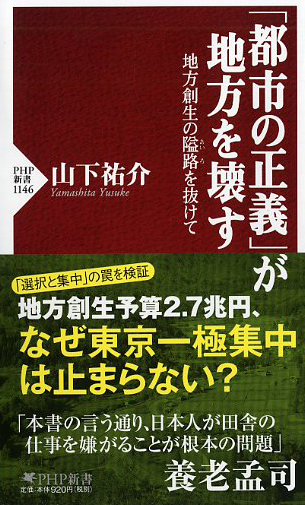
"What stands out when reading this report is that while it calls for confronting population issues, it seems to be constantly concerned with economic and industrial problems. No, even more so, the report's interest seems to be in financial issues. (omitted) When the population declines, the economy shrinks, and public finances (revenue) dwindle. This means that the same level of spending as before is no longer possible, and it becomes impossible to protect all regions. Therefore, we must implement 'selection and concentration', separating regions to be preserved from those that should not be preserved, severing the unpreserved regions early, and concentrating the population in the regions to be preserved, all while considering overall survival. (omitted) Now, what are the criteria for separating regions to be preserved from those that should not? First and foremost, it is 'population size'. (omitted) For regions below a certain size, the message is, We can't afford to spend any more money on this. (omitted) Secondly, it is whether or not the region has achieved 'advanced industrialization'. Regions with high productivity, a larger economy than others, secure tax revenues, and established sustainable administrative and financial systems—these are the regions that will survive. Now, these regions that have achieved a certain level of population size and density, and where advanced industries are concentrated, It is a 'city'." (Quoted from book [10-2], pages 31-32).
The idea that it's acceptable for rural areas lacking economic value to disappear is fundamentally the same as not extending a helping hand to impoverished people in the surrounding areas around the world who are suffering and unable to survive. However, just as the wealth of the rich is acquired through the labor of the poor, urban life relies not only on agricultural and marine products produced in rural areas, but also on the cultural and performing arts resources passed down through generations, as well as the rich natural tourism resources that rural areas provide. Is it really appropriate to draw the line solely on population and economic value? Furthermore, people will find it difficult to live in urban environments with little to no sea, mountains, or greenery, and we must consider the further disappearance of rural areas that consider the balance between people and nature.
"They pick out a certain region and say, 'We can't protect you anymore. Please disappear,' or they point to people living ordinary lives and say, 'We can't spend any more money on you. Either disappear or become a recipient of welfare.' The urban justice that includes 'selection and concentration' is inherent in this objectivism that denies 'life = subjectivity.' It implies that large human groups are right and worth living, while small groups are wrong and not worth living." (Quoted from book [10-2], page 36).
Both the neoliberalism rampant worldwide and regional revitalization in Japan only think about 'money'. It's a greedy individualism (the mindset of the strong, who only care about themselves) that forces competition by demanding growth or threatening extinction, leading to further exploitation. Ideally, instead of gathering people in cities to streamline top-down administration, shouldn't we be promoting local autonomy and providing financial support?
"Both regional extinction and regional revitalization did not directly address population decline or the over-concentration of population in Tokyo. The decline of rural areas is seen as a concentration of people in cities of around 200,000. And the focus of regional revitalization has shifted to 'creating new jobs in rural areas'. What they all have in common is that while talking about people (population), they stray from that and start talking about money (economy, finance, industry). (omitted) This country is currently making various demands on local areas to stop population decline, but isn't that precisely the root cause of the decline? Regional revitalization, driven by urban ideals, is actually pushing the over-concentration of population in Tokyo, causing rural areas to decline, and hindering population reproduction. This seems to be a possible analysis." (Quoted from book [10-2], pages 63-65).
In other words, it can be concluded as follows: For example, in the Tokyo metropolitan area, rent and living expenses are high, requiring both parents to work; it's difficult to live with grandparents and receive help with childcare; and daycare centers are full, making enrollment difficult. Imagine the current situation where you can't have children because you can't take parental leave at a performance-oriented workplace. Furthermore, cities are sick, with issues like soaring land prices and lonely deaths.
"Attributing the decline in the birth rate to economics is problematic. Of course, if employment increases and the number of young people increases in a certain area, the birth rate in that area will increase. However, that is an effect of migration, and whether the fertility (rate) has recovered is another matter (in fact, birth rates are often low in areas with rapid population growth). (omitted) And urbanization (population growth, high density) is directly proportional to the expansion of the economy, and as we have already seen, urbanization leads to a decrease in fertility. Therefore, if there is a close relationship between urbanization and economic growth, strengthening the economy may actually lead to further population decline." (Quoted from book [10-2], pages 74-75).
"Hasn't there been a widespread trend to view society solely from an economic and fiscal perspective, thereby condoning policies that disregard the human condition? Isn't this actually the essence of what we call 'neoliberalism'? And isn't this 'urban justice, exemplified by neoliberalism, the very thing that disrupts the balance of the nation and leads to a declining birthrate?" (Quoted from book [10-2], page 111).
On the other hand, it seems we ourselves are unconsciously creating unfounded hierarchies, assuming that everything, including work, is inferior in rural areas and superior in urban areas. Of course, there are attractive and important jobs in rural areas as well. Furthermore, a job to be proud of isn't determined solely by its (earning) economic aspects; it's determined by diverse values such as having ample free time, a quiet living environment, cheap and delicious food, and contributing to society. Moreover, it's not just any profitable job that's good; it should be one that doesn't destroy nature, isn't dangerous, doesn't disrupt daily life, and protects people's lives.
"Even for the same job, jobs performed in the metropolitan area are considered higher in status, while jobs in rural areas have lower prestige. Isn't that the case? Similarly, within rural areas, urban jobs have higher prestige than rural jobs, and within cities, the larger the city's population, the higher the prestige." (Quoted from book [10-2], page 84).
Eventially, policies that seem almost violent are being pursued, focusing solely on finance or economics (money), threatening to eliminate regions under the guise of regional revitalization and inciting competition. However, unless the current situation—where outside companies (mostly powerful urban players) siphon off profits through the hole in the bucket, as illustrated in Episode 6 is improved, no matter how hard efforts are made, the region will not benefit, and it will only be a one-sided pursuit of profit for outsiders. Ideally, urban dwellers should purchase locally produced food and other goods, visit and stay in these areas as tourists, enriching the local economy and creating employment, which in turn sustains these industries and tourism sectors for urban dwellers to utilize—a mutually beneficial relationship. The more isolated a village is, the more its disappearance would leave it as a barren wilderness inaccessible to people, making it impossible to obtain valuable food and unique experiences.
"The goal of regional revitalization was to create a virtuous cycle of towns, people, and jobs. However, from the outset, it focused solely on 'jobs.' The moment it became concentrated, this policy failed. The flow stopped, and circulation ceased. A stagnant process creates strain everywhere, robbing people of room for creativity and ingenuity. (omitted) The most important thing missing from the current urban justice is circulation. What happens when circulation disappears? Dependence remains mere dependence. It ceases to be codependency. And above all, it becomes impossible to solve problems." (Quoted from book [10-2], pages 249-250).
In Episode 11, we will outline, based on cutting-edge network science insights, what constitutes an optimal structure that is less susceptible to fragmentation even in the event of disasters or attacks. If fragmentation can be avoided, various forms of circulation will become possible.