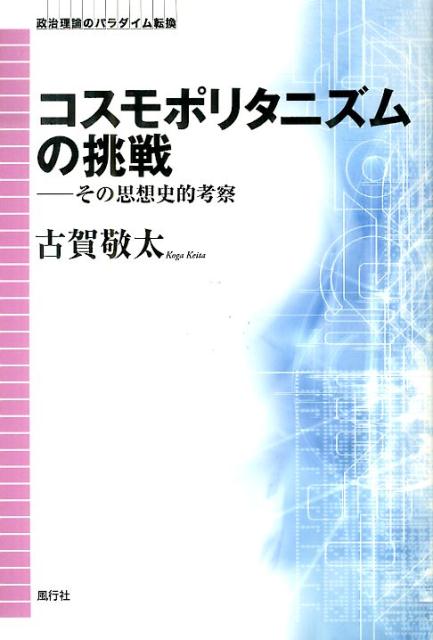
『The Challenge of Cosmopolitanism: A Historical Examination of Its Ideas』
Fukosha (2014/6/1), ISBN-13: 978-4938662745
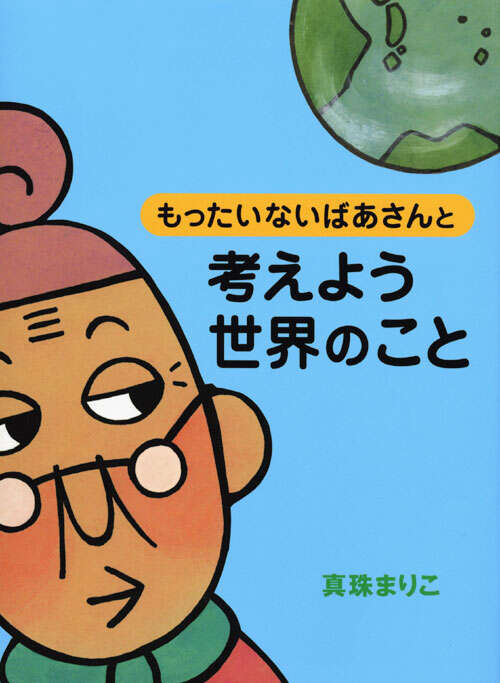
『Let's think about the world with Grandma Mottainai』
Kodansha(2008/7/5), ISBN-13: 978-4062147774
Series: Learning about cutting-edge science and human history to prevent social division
"The defining characteristic of cosmopolitanism is that all people, as members of the 'human community' and as 'human beings,' possess equal ethical values and dignity. (omitted) Cosmopolitanism does not necessarily deny the sense of belonging or identity to a region, ethnicity, or nation. It affirms it while simultaneously striving to transcend it. At the same time, it regulates excesses to prevent such a sense of belonging and identity from becoming exclusive. (omitted) The view that a 'world government' tends to be centralized and uniform, thus endangering cultural and political diversity, is shared even among cosmopolitans. (omitted) The words 'human being' and 'humanity' differ from the words 'homeland' and 'ethnicity'. It is unlikely to become an ideology of war that will awaken the passions of nations. (omitted) Moral cosmopolitanism that conveys a common humanity has the potential to develop into legal cosmopolitanism that grants rights and obligations to global citizens." (Quoted from book [12-1], pages 2-5).
"The central framework of this book's structure is cosmopolitanism versus the nation-state, and this conflict is the central axis around which the discussion unfolds. Therefore, there is debate among cosmopolitans themselves, and fierce debate has also taken place among those who support the nation-state. (omitted) Furthermore, the conflict between cosmopolitanism and the nation-state is, naturally, not the same as the conflict between neoliberalism, which rejects the redistribution of wealth, and social democracy, which advocates for its redistribution. (omitted) The issue boils down to one point: whether to achieve social justice and the redistribution of wealth across national borders. The criteria for evaluation in this regard depend on whether the principles of social justice are universally applicable across national borders, or whether the concept of justice is constrained by historical and cultural values." (Quoted from book [12-1], pages 8-9).
"In its preamble, the Universal Declaration of Human Rights states that 'the recognition of the dignity and equality of all members of the human family as inalienable rights is the basis of liberty, justice and equality in the world,' and Article 1 states that 'all men are born liberated and equal in dignity and rights.' They are endowed with reason and conscience and should act upon one another in the spirit of brotherhood, thus embodying the spirit of cosmopolitanism. (omitted) The Universal Declaration of Human Rights is composed of three pillars, which correspond to the rights of 'human personality', 'civil personality' and 'social and labor personality' in Maritain's 'Man and the State'. Rights attached to human personality include the 'right to life' and 'personal liberties,' while the rights of 'civil personality' include the right to vote, and the rights of 'social or labor personality' include the right to work, the right to choose one's occupation, the right to form a trade union, the right to wages sufficient to secure a family's livelihood, and the right to receive social security such as unemployment insurance and sickness pensions." (Quoted from book [12-1], pages 67-69).
"Held's contributions to cosmopolitanism are, firstly, his opposition of global social democracy to the neoliberal 'Washington Consensus,' and secondly, his attempt to expand democracy from the framework of the nation-state to the global sphere." (Quoted from book [12-1], page 170).
"Held's attempt is not to reject national democracy based on language and territory, but rather to create a global public sphere that transcends territory and language in a layered manner with it. (omitted) Held points out that cosmopolitan sovereignty prevents the excesses of market mechanisms and economic power, extends representation to developing countries in international financial institutions such as the IMF, and necessitates the enactment of cosmopolitan economic laws such as global taxation (energy consumption tax, carbon emission tax, global tax on the extraction of domestic resources, tax on GNP countries exceeding a certain level of development, and tax on the volume of financial transactions in the foreign exchange market). A series of taxes can serve as a source of funding for cosmopolitan governance and the redistribution of wealth to poorer countries." (Quoted from book [12-1], pages 191-194).
"Miller's theory of justice is underpinned by a view of autonomous humanity, which recognizes that while humans are poor and vulnerable, they are also capable of making choices and taking responsibility for their own lives." (Quoted from book [12-1], page 362).
"What exactly is the challenge of cosmopolitanism? Perhaps it is considering the international order from the standpoint of a 'global citizen' in today's world, where globalization is progressing and cross-border interdependence is advancing. This is a sense of crisis, recognizing that humanity is on a single ship, and that ship is in danger of capsizing. Modern cosmopolitanism is not an illusion supported by an optimistic view of humanity or history, but rather a prescription for overcoming a common crisis facing humankind. In particular, the challenge of cosmopolitanism teaches us to transcend the nation-state-based human rights protection and democracy that we have implicitly defined our thinking as self-evident. We must not criticize the challenge of cosmopolitanism as abstract and rootless, but rather firmly embrace it. A 'paradigm shift' from a nation-state-centered paradigm to a cosmopolitanism-centered paradigm is required. (Quoted from book [12-1], pages 376-377).
"This book describes the current state of the world and various problems surrounding children, such as climate change, disasters, food and water shortages, war, and poverty, and explains how they are connected to our lives. These are all problems that I believe wouldn't have happened if we had prioritized life above all else." (Quote from book [12-2], pages 2-3).
"Karim doesn't go to school. His whole family has to pick up trash to earn enough money to buy food for the day, so Karim, like everyone else, doesn't go to school and instead picks up trash. He picks up recyclable materials like empty cans, plastic, and glass. (omitted) Karim used to live in the forest, subsisting on its abundant bounty. However, in order to earn money, he cut down many trees in the forest, which ruined the land and prevented crops from growing, so he moved to the city. Because he has no money, he lives in a place called a 'slum', where poor people live. (Quoted from book [12-2], pages 26-27).
"Solosis was kidnapped, forced to become a soldier, and after about two weeks of gun training, was immediately sent to the battlefield. If he says he's scared, he's injected with a drug that makes him not scared. This makes his head feel hazy, and he no longer feels scared. Some children have drugs implanted in their bodies. Some children are forced to walk through fields full of landmines, being told to 'go ahead!' If you step on a landmine, it explodes with a bang! But after that, there are no more landmines, so the adults walk over it. They let the children walk first, let them step on the landmines, and then they walk over themselves. (omitted) Doesn't it seem like they're treating the children like fighting machines? (omitted) It's the same with the children who are forced to work. They're treated like working robots. It's as if they don't think of them as human beings." (Quoted from book [12-2], pages 34-35).
"Forests are disappearing from the Earth at an incredible speed. Every year, an area of forest roughly the size of Hokkaido, Kyushu, and Shikoku combined disappears. Forests disappear because trees are being cut down. Trees are cut down to sell them for money, or to create fields by cutting down trees that originally grew there in order to grow crops that can be sold for a higher price. (omitted) As forests that stored water disappear, floods become more likely downstream, and in some places, deserts form. Once a place becomes a desert, it is not easy to restore it to its original state. Food cannot be grown in barren land or deserts, so the people who lived there have to move to other places. (omitted) Also, not only humans, but when forests disappear, the creatures that lived there also disappear. The nutrients in the soil flow out little by little, passing through rivers and nourishing marine life, but when forests disappear, the nutrients that flow in disappear, Furthermore, soil containing pesticides flows in, polluting rivers and seas, and preventing marine life from thriving. (omitted) The disappearance of forests means the disappearance of life. It's a waste ('Mottainai' in Japanese) not to cherish the forests." (Quoted from book [12-2], pages 56-57).
"Forests contain many different kinds of trees, each with its own role, and they complement each other's weaknesses, creating a balance throughout the forest. However, if you cut down these trees and plant many of only one type of tree that wasn't originally there, problems are more likely to occur. (omitted) If you only look at short-term gains, you might lose everything. In the end, all that will be left is barren land." (Quoted from book [12-2], pages 58-59).
"In poor countries, poor people, because they have no money, even their children can't go to school and have to work, they can't even buy food for the day, they drink contaminated water and get sick, or even lose their lives. (omitted) Don't you think that's strange? We're all inhabitants of the same planet, yet there's such a difference. (omitted) Our lives are by no means unrelated to the poor in poor countries. For example, some of the ten foods on our table, only four are made in Japan, and the other six are bought from abroad, so perhaps they were brought in from a poor country. Our purchases may drive up the price, making it impossible for those people to afford them. Perhaps some of the paper we use is made from trees cut down in forests due to poverty. And perhaps some of the things around us were made by children who didn't go to school and worked from morning till night. It might be chocolate, a soccer ball, or a T-shirt. As fellow inhabitants of this planet, we are all connected." (Quoted from book [12-2], pages 74-75).
"If we don't think 'as long as I'm okay', but instead have a willingness to share, a peaceful world will surely be possible. Let's think about how we can all live happily together. It would be a waste ('Mottainai' in Japanese) not to do what we can!" (Quoted from book [12-2], page 76).
|
|
[12-1] K.Koga,
『The Challenge of Cosmopolitanism: A Historical Examination of Its Ideas』 Fukosha (2014/6/1), ISBN-13: 978-4938662745 |
|
[12-2] M.Shinjyu,
『Let's think about the world with Grandma Mottainai』 Kodansha(2008/7/5), ISBN-13: 978-4062147774 |