

研究活動の検索
研究概要(研究室ガイド)やプレスリリース・受賞・イベント情報など、マテリアルサイエンスの研究室により公開された情報の中から、興味のある情報をタグや検索機能を使って探すことができます。結晶が成長する様子を観察してメカニズムを探る

結晶が成長する様子を観察してメカニズムを探る
次世代シリコン太陽電池研究室
Laboratory on Next-Generation Silicon Photovoltaics
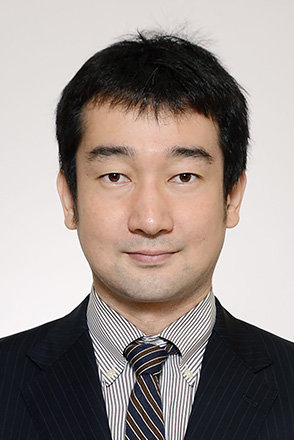
講師:前田 健作(MAEDA Kensaku)
E-mail:
[研究分野]
結晶成長、太陽電池、非線形光学
[キーワード]
その場観察、結晶粒界、双晶
研究を始めるのに必要な知識・能力
学部や高専で習う基礎的な物理や数学の知識
思い込みで実験結果を判断せず、公平な視点で研究に取り組む姿勢
この研究で身につく能力
研究活動を通して、実験装置(ガス制御機構、加熱機構、顕微鏡など)の使い方やデータの収集と解析方法が身につきます。
また、定期的なゼミ活動や随時のディスカッションを通して、コミュニケーション能力や問題解決能力が鍛えられます。
失敗と思えるような実験から新しい発見が生まれることはよくあります。普通は気付けないような特徴を注意深く読み取る力や俯瞰的かつ合理的に考察する力など、修了後に社会で活躍する際にも役立つ能力を鍛えて欲しいと願っています。
【就職先企業・職種】 製造業など
研究内容
エレクトロニクス、オプトエレクトロニクスの発展を進めるには、材料となる結晶の高品質化や高性能化が不可欠です。結晶とは原子が規則正しく整列した固体であり、融液や溶液などの環境相から徐々に大きく成長することで形成されます。「成長」という言葉は主に生物に対して使われますが、立派な人間に成るには成長過程が重要であることと同様に、高性能な結晶を得るには成長過程が重要となります。この成長過程を注意深く観察することでメカニズムを解明し、高機能結晶を育てる技術を開発します。
1.薄膜多結晶シリコンの形成過程のその場観察
太陽電池の基板材料には半導体のシリコンが広く用いられています。薄膜多結晶シリコンはガラス基板上の非晶質シリコンにパルス光(フラッシュランプアニール光)を当てることで作ることができ、インゴットを薄くスライスして作る結晶基板よりも生産性とコスト面で優れています。非晶質シリコンが多結晶化する過程を観察することで、太陽電池の劣化の原因となる組織の形成機構を解明し、その形成を抑制する技術を開発します。
2.レーザー波長変換素子(周期双晶結晶)の作製
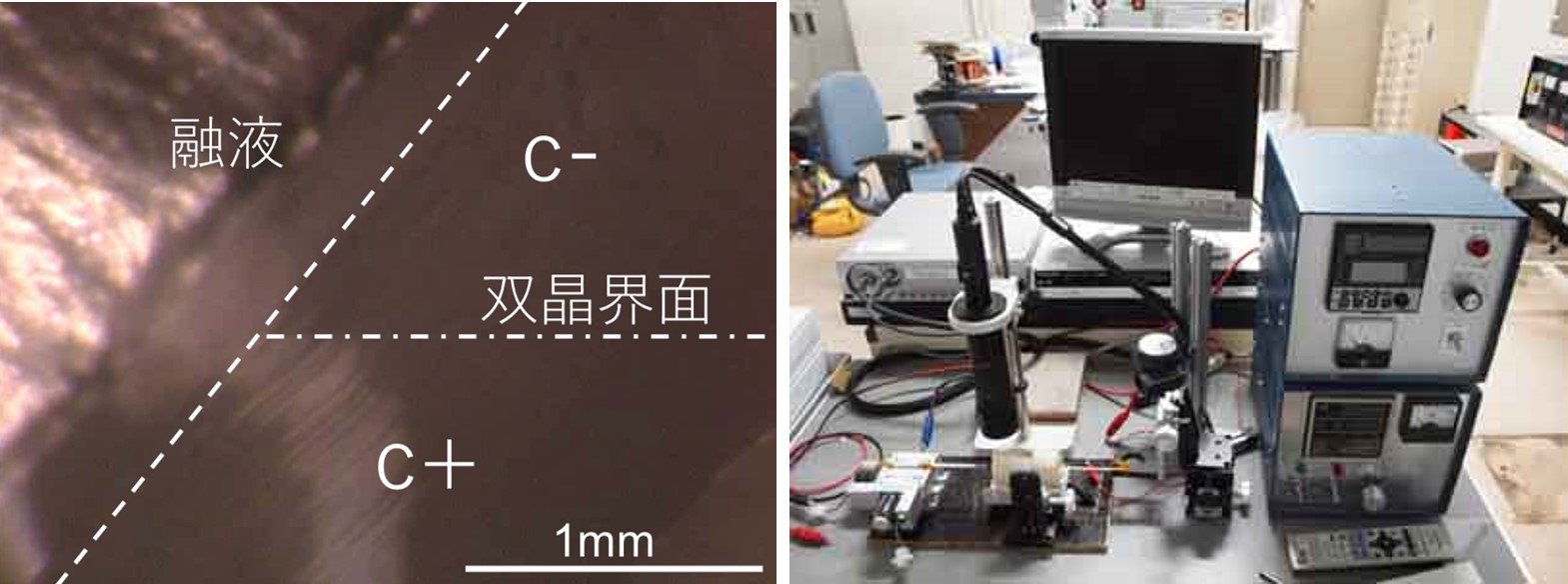
Li2B4O7の双晶成長過程(左)、顕微鏡観察炉(右)
半導体リソグラフィの極微細化やレーザー加工の超高精度化に伴い、高エネルギー効率で小型の全固体レーザー光源の短波長化が求められています。全固体レーザーは固体レーザーを非線形光学結晶により波長変換することで実現でき、光源にガスを用いるよりも安定で小型な装置となります。
非線形光学結晶の分極を周期的に反転することで変換効率を向上でき、強誘電体に電界印加することで生産されています。本研究では非強誘電体においても周期構造を導入するために、双晶形成を用いた反転技術の開発に取り組んでいます。
3.化合物半導体の融液成長過程の観察
シリコンSiは地殻中で酸素に次いで2番目に多い元素であり、単結晶シリコンは半導体デバイスの基板材料として世界中で広く生産されています。化合物半導体(InSb, GaSb, GaAsなど)の生産量は少ないですが、これからのエレクトロニクスの発展に無くてはならない結晶であり、単結晶育成技術の開発は重要です。結晶が成長する様子を観察して、双晶や粒界などの欠陥がどのように形成されるのか、そのメカニズムを解明することを目指しています。
主な研究業績
- K. Hu, K. Maeda, H. Morito, K. Shiga, K. Fujiwara, In situ observation of grain-boundary development from a facet-facet groove during solidification of silicon, Acta Materialia, 153, 186(2018).
- K. Maeda, A. Niitsu, H. Morito, K. Shiga, K. Fujiwara, In situ observation of grain boundary groove at the crystal/melt interface in Cu, Scripta Materialia, 146, 169(2018).
- K. Maeda, S. Uda, K. Fujiwara, J. Nozawa, H. Koizumi, S. Sato, Y. Kozawa, T. Nakamura, Fabrication of Quasi-Phase-Matching Structure during Paraelectric Borate Crystal Growth, Applied Physics Express, 6, 15501(2013).
研究室の指導方針
研究活動は自主性を重んじる方針で、学生自身の発想が研究に活かせます。毎朝一度、研究室メンバー全員が集まるミーティングを行い、その日の各自の活動を報告します。ミーティングでは、簡単な研究の相談もでき、メンバー間のコミュニケーションも十分行えるシステムです。当番の学生が文献紹介を行う勉強会では、細部にわたる質問への回答が求められ、しっかりとした基礎学力が身につきます。学術会議などでの外部発表は、積極的に行います。また、博士前期課程期間中に、英語の論文を執筆し投稿できるよう指導します。
[研究室HP] URL:https://www.jaist.ac.jp/ms/labs/ohdaira/
学生の島袋さんが第23回Cat-CVD研究会において優秀学生ポスター賞を受賞
学生の島袋颯馬さん(博士前期課程2年、ナノマテリアル・デバイス研究領域、大平研究室)が第23回Cat-CVD研究会において優秀学生ポスター賞を受賞しました。
第23回Cat-CVD研究会は、令和8年6月18日・19日に旧大連航路上屋(福岡県北九州市)で開催され、Cat-CVD技術を用いた薄膜やデバイスの作製をはじめ、基礎から応用まで幅広い分野における最新の研究成果について、活発な議論が行われました。
優秀学生ポスター賞は、学部学生および大学院生を対象に、日々の研究活動を奨励することを目的として、同研究会において特に優れたポスター発表を行った学生に贈られる賞です。
※参考:Cat-CVD研究会
■受賞年月日
令和8年6月19日
■研究題目、論文タイトル等
レーザー補助FLAによるCat-CVD a-Si膜の結晶化の起点形成効果
■研究者、著者
島袋颯馬、前田健作、大平圭介
■受賞対象となった研究の内容
本研究では、非晶質シリコン膜の結晶化過程で生じる爆発的結晶化について、その発生起点を能動的に制御する手法を提案し、実験的に実証しました。爆発的結晶化は、多結晶シリコン膜を高速に形成できる技術として期待されていますが、結晶化が始まる位置を制御することが難しいという課題があります。本研究では、フラッシュランプアニールとパルスレーザー照射を組み合わせることで、任意の位置から爆発的結晶化を誘起することに成功しました。また、起点形成に必要なレーザーエネルギー密度が比較的低いことを明らかにしました。
■受賞にあたって一言
このたびは、第23回Cat-CVD研究会において優秀学生ポスター賞を受賞することができ、大変光栄に思います。本研究は、Cat-CVD法で作製した非晶質シリコン膜の応用研究として取り組んできたものです。本研究会において、結晶成長の観点から研究成果を発表し、多くの方々に興味を持っていただけたことを大変うれしく思います。日頃よりご指導いただいている大平圭介教授、前田健作講師をはじめ、研究を支えてくださった研究室および研究スタッフの皆様に、心より感謝申し上げます。今回の受賞を励みとして、今後も研究活動に精進してまいります。


令和8年9月7日
出典:JAIST 受賞https://www.jaist.ac.jp/whatsnew/award/2026/09/07-1.html学生のSUMALDEさんがPVSEC-36においてBest Oral Presentation Awardを受賞
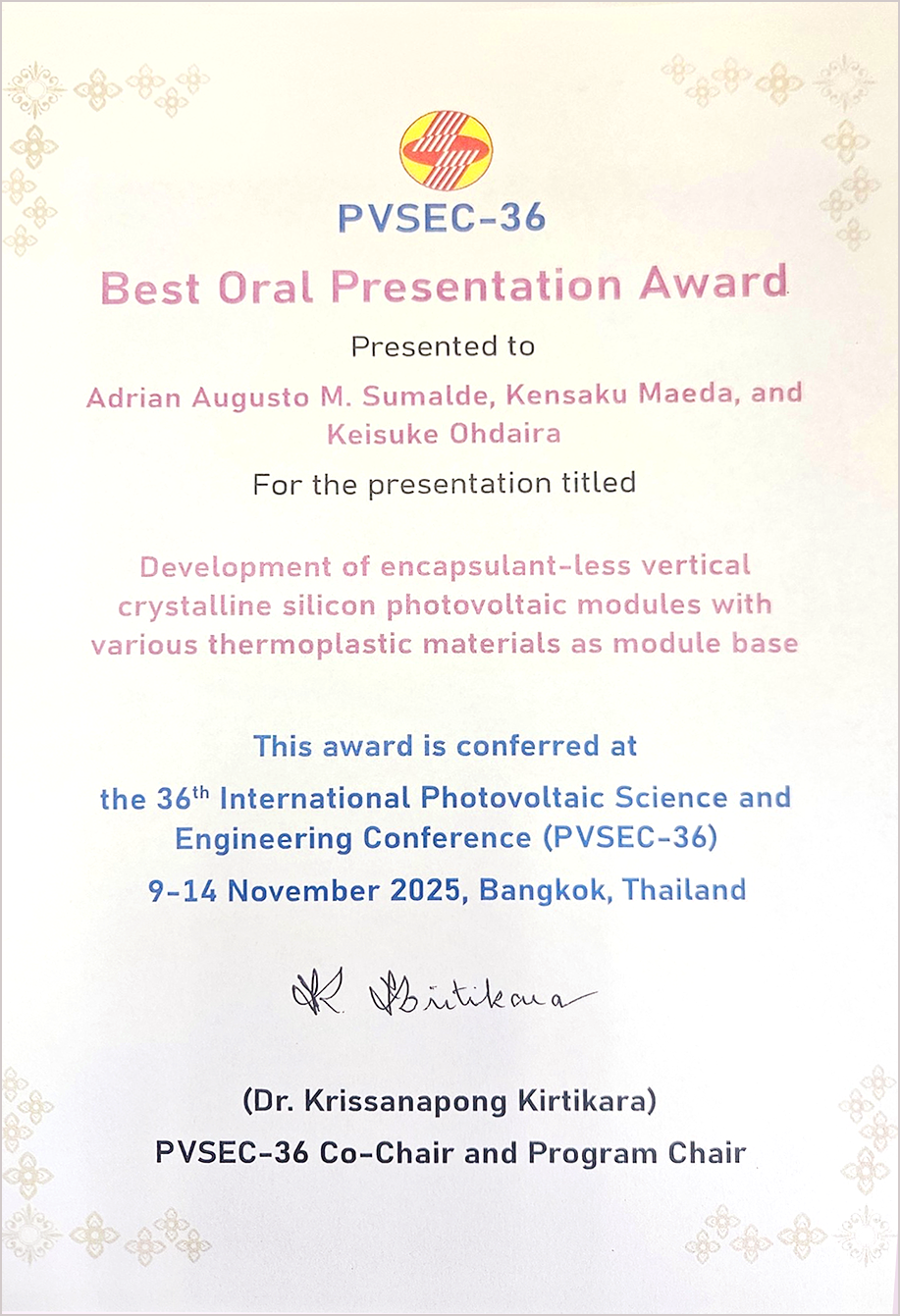
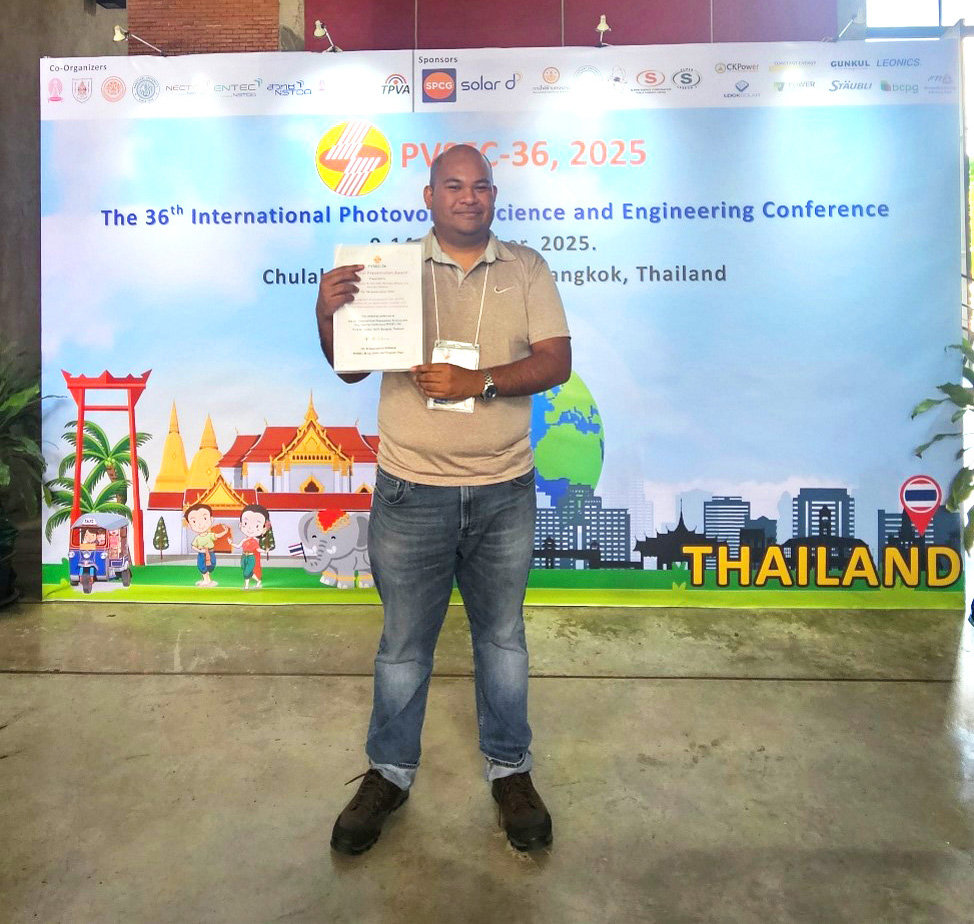
学生のSUMALDE, Adrian Augusto Mendozaさん(博士後期課程2年、サスティナブルイノベーション研究領域、大平研究室)が36th International Photovoltaic Science and Engineering Conference(PVSEC-36)においてBest Oral Presentation Awardを受賞しました。
PVSEC-36は、令和7年11月9日~14日まで、タイ・バンコクのチュラロンコン大学(Chulalongkorn University)にて開催された、太陽光発電システムに関する国際会議です。同会議では、世界中の研究者や技術者が一堂に会し、最先端の研究成果について活発な議論が行われました。
※参考:PVSEC-36
■受賞年月日
令和7年11月14日
■研究題目、論文タイトル等
Development of encapsulant-less vertical crystalline silicon photovoltaic modules with various thermoplastic materials as module base
■研究者、著者
Adrian Augusto M. Sumalde, Kensaku Maeda, and Keisuke Ohdaira
■受賞対象となった研究の内容
Encapsulant-less PV modules were developed to address the recyclability concerns in conventional crystalline silicon (c-Si) photovoltaic (PV) modules. Specifically, these modules were conceptualized for vertical installations for building integration, targeting high urban density areas and/or locations with heavy snowfall conditions. This work evaluated the potential of several thermoplastics as primary material for module base, providing both physical stability and aesthetic appeal. The design utilizes grooves for easy installation and removal of module components, as well as "corner" and "bar" holding structures to minimize partial shading and vertical stability. Mini-modules were 3d-printed using black polycarbonate (PC), translucent polyethylene terephthalate glycol (PETG), and white acrylonitrile styrene acrylate (ASA). Electrical performance was evaluate using 1-sun illuminated J - V characteristics, EQE spectra, and electroluminescence imaging, while an initial 72-hour damp-heat test was conducted to investigate the response of modules to thermo-hygrometric stress. Using corner holding structures in the module base design, performance losses were successfully minimized, kept to as low as 0.36% ηabs for the white ASA modules. The translucency of PETG modules and white colors of ASA modules also resulted in cell-to-module ratios above 90%, with confidence that upscaling will improve these values. Future direction involves upsizing and redesigning for additional physical stability, to be evaluated using moisture ingress and vibration stability tests.
■受賞にあたって一言
I am truly honored to have received the award at PVSEC-36. It validated my efforts throughout the year and motivates me to continue working hard in my research and my PhD studies. I would like to thank Professor Keisuke Ohdaira and Senior Lecturer Kensaku Maeda for their continuous guidance and instilling discipline in my daily research activities in JAIST, as well as to NEDO and Specially Appointed Professor Marwan Dhamrin, The University of Osaka, for their technical support for the fabrication of our solar cells. Lastly, I would also like to thank Associate Professor Kotona Motoyama, Kanazawa University, who strengthened my awareness of responsible research and innovation. Through her, I am always reminded that whenever we communicate our research, the benefit to society is a common language that we all can understand.
令和7年12月9日
出典:JAIST 受賞https://www.jaist.ac.jp/whatsnew/award/2025/12/09-1.html